

Working in finance doesn’t always begin with becoming an accountant or financial analyst. Many professionals start as a Finance Accounts Assistant, a role that provides practical exposure to bookkeeping, financial reporting, payment processing, budgeting, and business operations. It is one of the most effective entry points into the finance industry because it combines technical accounting knowledge with real-world business experience.
Whether you are a recent graduate, someone planning a career change, or a business owner looking to understand the value of this position, learning about the responsibilities and career opportunities of a finance accounts assistant can help you make informed decisions.
Unlike many career guides that simply list job duties, this guide explains how the role contributes to the financial health of an organization, which skills employers truly value, and how beginners can grow into higher-paying finance positions over time.
By the end of this article, you’ll understand not only what a finance accounts assistant does but also why this position remains one of the most stable and versatile careers in today’s business environment.
A finance accounts assistant supports an organization’s accounting department by processing invoices, reconciling bank accounts, maintaining financial records, assisting with payroll, and preparing reports. The role develops practical finance skills and serves as an excellent starting point for careers in accounting, financial analysis, and finance management.
What Is a Finance Accounts Assistant?
A finance accounts assistant is a finance professional who supports the accounting and finance department by handling daily financial tasks, maintaining accurate records, assisting with reporting, processing transactions, and ensuring financial information remains organized.
Think of this role as the operational backbone of a finance department. While senior accountants analyze financial performance and finance managers make strategic decisions, finance accounts assistants ensure that the underlying financial data is accurate, complete, and available when needed.
In small businesses, a finance accounts assistant may handle a wide range of responsibilities, from processing invoices to assisting with payroll. In larger organizations, the role is often more specialized, focusing on areas such as accounts payable, accounts receivable, expense management, or financial reporting.
Practical Takeaway: Accuracy and organization are the defining qualities of a successful finance accounts assistant. Strong attention to detail often matters more than advanced accounting knowledge when starting out.
Why This Role Matters More Than Ever
Every financial decision within a business relies on reliable data. If invoices are entered incorrectly, payments are delayed, or expenses are recorded inaccurately, the impact extends far beyond the finance department.
Businesses today operate in an environment where compliance, transparency, and real-time reporting are increasingly important. Governments require accurate tax reporting. Investors expect reliable financial statements. Business leaders depend on timely financial information to make decisions.
A finance accounts assistant plays a direct role in maintaining this financial accuracy.
Consider a growing online retail company processing hundreds of supplier invoices each month. If payment records are not updated promptly, vendors may suspend deliveries, affecting inventory levels and customer satisfaction. A well-organized finance accounts assistant helps prevent these operational disruptions before they occur.
This behind-the-scenes contribution often goes unnoticed, yet it directly supports business continuity.
Practical Takeaway: Finance accounts assistants don’t just record numbers—they help businesses operate smoothly by ensuring financial information is dependable.
Where Finance Accounts Assistants Work
One of the biggest advantages of this career is its flexibility. Almost every industry requires finance professionals, creating opportunities across multiple sectors.
Common employers include:
- Banks and financial institutions
- Healthcare organizations
- Manufacturing companies
- Retail businesses
- Technology firms
- Government departments
- Educational institutions
- Construction companies
- Logistics providers
- Hospitality businesses
- Insurance companies
- Non-profit organizations
- Professional service firms
- E-commerce businesses
- Startups
Each industry presents unique financial processes, allowing professionals to build specialized expertise over time.
For example, a finance accounts assistant working in manufacturing may regularly reconcile supplier invoices and inventory costs, while someone in healthcare may process insurance payments and patient billing.
Changing industries later in your career is also possible because the underlying accounting principles remain largely consistent.
Practical Takeaway: Industry knowledge becomes increasingly valuable as your career progresses, but strong accounting fundamentals transfer across sectors.
Understanding the Daily Workflow
Many people imagine accounting as spending the entire day entering numbers into spreadsheets. In reality, the work is far more dynamic.
A typical day often begins by reviewing emails from suppliers, customers, and internal departments. New invoices are checked for accuracy before being entered into the accounting system.
Payments scheduled for the day are verified against purchase orders and approval records. Bank transactions are downloaded and compared with accounting records to identify discrepancies.
Expense claims submitted by employees are reviewed to ensure they comply with company policies.
Throughout the day, finance accounts assistants respond to questions from vendors, assist colleagues with payment information, update financial records, and help prepare reports requested by management.
Toward the end of the month, responsibilities become more intensive as businesses prepare for month-end closing. Additional reconciliation work, report preparation, and data verification are often required during this period.
This combination of routine processes and problem-solving keeps the role engaging.
Practical Takeaway: Time management becomes especially important during month-end and year-end financial closing periods.
The Finance Operations Pyramid™: An Original Framework for Understanding the Role
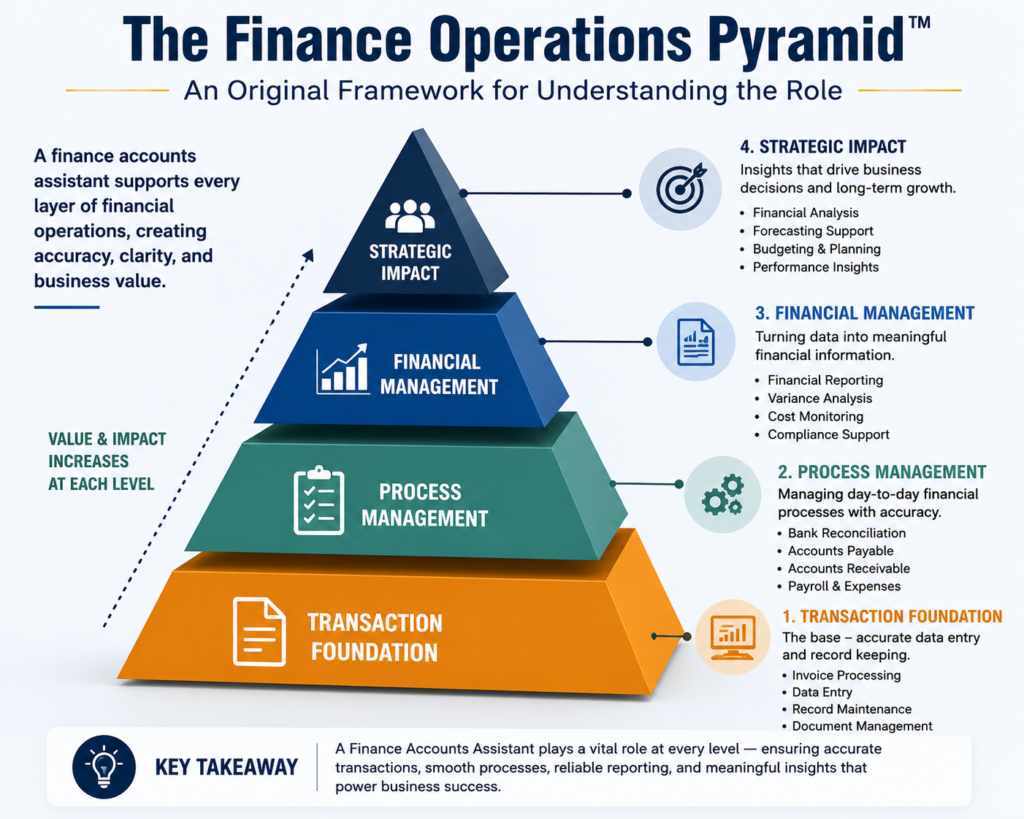
Instead of viewing accounting tasks as isolated activities, imagine them as a four-level operational pyramid.
Level 1: Financial Data Collection
Every transaction begins here.
Examples include:
- Supplier invoices
- Customer receipts
- Employee expenses
- Bank transactions
- Purchase orders
Without complete information at this level, every higher financial process becomes less reliable.
Level 2: Verification and Recording
Collected information must be validated before being entered into accounting software.
This stage involves:
- Checking invoice details
- Matching supporting documents
- Confirming payment approvals
- Reviewing tax information
- Preventing duplicate entries
Small errors discovered early prevent larger financial problems later.
Level 3: Financial Control
Once transactions are recorded, they must be monitored.
Examples include:
- Bank reconciliations
- Outstanding invoices
- Payment schedules
- Budget tracking
- Expense monitoring
This stage protects the organization against financial mistakes and operational inefficiencies.
Level 4: Business Decision Support
The highest level transforms financial records into meaningful information.
Managers use reports generated from accurate accounting records to:
- Monitor profitability
- Control spending
- Forecast cash flow
- Plan investments
- Improve operational efficiency
Although finance managers often present these reports, their quality depends heavily on the accuracy of work completed by finance accounts assistants.
Practical Takeaway: Every task completed by a finance accounts assistant contributes to better business decisions further up the organizational chain.
Core Responsibilities Explained
The responsibilities of a finance accounts assistant vary between organizations, but most roles include a combination of operational accounting and administrative support.
Some of the most common responsibilities include:
Processing Purchase Invoices
Supplier invoices must be reviewed carefully before payment.
This includes confirming:
- Supplier details
- Invoice dates
- Purchase order references
- Tax information
- Payment terms
- Approval status
Attention to detail reduces duplicate payments and accounting errors.
Managing Accounts Payable
Accounts payable focuses on money the company owes to suppliers.
Typical activities include:
- Recording supplier invoices
- Scheduling payments
- Monitoring due dates
- Resolving invoice disputes
- Updating payment records
Efficient accounts payable management helps maintain strong supplier relationships.
Supporting Accounts Receivable
Accounts receivable involves money customers owe the business.
Finance accounts assistants often:
- Generate invoices
- Track outstanding balances
- Send payment reminders
- Allocate incoming payments
- Reconcile customer accounts
Healthy cash flow depends on effective receivables management.
Bank Reconciliation
One of the most valuable accounting tasks involves comparing accounting records with actual bank transactions.
Differences may result from:
- Outstanding payments
- Bank charges
- Recording mistakes
- Timing differences
Identifying these discrepancies early improves financial accuracy.
Expense Administration
Employee expenses require careful review before reimbursement.
Finance accounts assistants ensure claims comply with company policies while maintaining supporting documentation for audit purposes.
Payroll Assistance
Some organizations involve finance accounts assistants in payroll preparation.
Responsibilities may include:
- Collecting timesheets
- Updating payroll information
- Recording salary journals
- Supporting payroll reconciliation
Strict confidentiality is essential when handling payroll information.
Practical Takeaway: While software automates many calculations, human review remains critical for identifying unusual transactions, documentation issues, and policy exceptions.
Comparison Table: Finance Accounts Assistant vs Bookkeeper
| Area | Finance Accounts Assistant | Bookkeeper |
|---|---|---|
| Primary Focus | Supports finance department operations | Maintains financial records |
| Scope | Broader administrative and accounting duties | Mainly transaction recording |
| Reporting | Assists senior finance staff | May prepare basic reports |
| Payroll Support | Frequently involved | Depends on business size |
| Supplier Management | Regular communication | Less common |
| Career Progression | Accountant, Financial Analyst, Finance Executive | Senior Bookkeeper, Accountant |
| Software Usage | Accounting software plus reporting tools | Primarily bookkeeping software |
| Business Interaction | Works across multiple departments | Mainly finance-focused |
Although these roles overlap, a finance accounts assistant typically has broader exposure to business operations, making it an excellent foundation for long-term career growth.
Mini Case Study: How Accuracy Prevented a Costly Error
A medium-sized distribution company received two invoices from the same supplier within a week. At first glance, both invoices appeared legitimate, but a finance accounts assistant noticed that the invoice numbers differed by only one digit while the amounts and purchase order references were identical.
Instead of processing payment immediately, the assistant contacted the supplier for clarification. It turned out that one invoice had been sent twice due to a system error. Catching the duplicate prevented an unnecessary payment and saved the company time that would have been spent recovering the funds.
This example highlights an important lesson: success in finance often depends on careful observation rather than complex calculations.
Section Takeaway
A finance accounts assistant is far more than an administrative support role. By maintaining accurate records, managing day-to-day financial processes, and ensuring reliable information flows through the organization, these professionals provide the foundation for informed business decisions. Mastering the responsibilities covered in this section creates the confidence and practical experience needed to advance into higher-level finance positions.
Qualifications That Help You Get Hired

One of the reasons the finance accounts assistant role attracts so many applicants is that there is no single mandatory career path. Employers hire candidates with different educational backgrounds, provided they demonstrate accuracy, reliability, and a willingness to learn.
A university degree can certainly improve opportunities, but many successful finance professionals begin with vocational training, certifications, or relevant work experience.
Common educational backgrounds include:
- Accounting
- Finance
- Business Administration
- Economics
- Commerce
- Mathematics
- Banking
- Management
Some employers also hire candidates without finance degrees if they possess strong numerical ability and administrative experience.
Do You Need Professional Certifications?
Certifications are not always required for entry-level roles, but they can significantly strengthen your resume and demonstrate commitment to the profession.
Examples include:
- AAT (Association of Accounting Technicians)
- ACCA Foundation Level
- ACCA Qualification
- CIMA Certificate
- CPA (where applicable)
- Bookkeeping certifications
- Payroll certifications
- Microsoft Excel certifications
Professional certifications also make it easier to transition into senior accounting positions later.
Practical Takeaway: If you’re starting from scratch, combining a basic accounting qualification with strong Excel skills often creates a more competitive profile than relying on education alone.
The Skills Employers Actually Look For
Many beginners assume employers mainly care about accounting formulas. In reality, hiring managers often prioritize reliability and problem-solving over technical expertise.
Technical Skills
A finance accounts assistant should gradually become comfortable with:
- Bookkeeping
- Accounts payable
- Accounts receivable
- Bank reconciliation
- Invoice processing
- Payroll support
- Budget monitoring
- Expense management
- Financial reporting
- Tax documentation
- General ledger basics
Knowledge of accounting principles becomes more valuable with experience.
Digital Skills
Modern finance departments rely heavily on technology.
Useful software includes:
- Microsoft Excel
- Google Sheets
- QuickBooks
- Xero
- Sage
- Zoho Books
- FreshBooks
- Microsoft Dynamics
- SAP
- Oracle Financials
Even if your employer uses different software, understanding one accounting platform makes learning another much easier.
Soft Skills
The most successful finance accounts assistants usually possess:
- Attention to detail
- Time management
- Organization
- Communication
- Confidentiality
- Critical thinking
- Adaptability
- Teamwork
- Professional ethics
- Customer service mindset
Finance teams interact with suppliers, customers, auditors, and internal departments every day, making communication an essential skill.
Practical Takeaway: Technical knowledge gets interviews, but professionalism and consistency often determine promotions.
The Software Stack Every Beginner Should Learn
Technology has transformed finance departments. Manual bookkeeping still exists, but automation now handles many repetitive calculations.
Instead of fearing automation, finance professionals should learn how to work alongside it.
A practical learning roadmap looks like this:
Stage 1
Master spreadsheets.
Learn:
- SUM
- IF
- VLOOKUP or XLOOKUP
- Pivot Tables
- Conditional Formatting
- Data Validation
- Charts
- Filters
Stage 2
Understand accounting software.
Focus on:
- Creating invoices
- Recording expenses
- Supplier management
- Customer records
- Bank feeds
- Reports
Stage 3
Learn reporting tools.
Examples include:
- Microsoft Power BI
- Tableau
- Excel Dashboards
Visualization skills are becoming increasingly valuable.
Stage 4
Understand automation.
Become familiar with:
- Automated bank reconciliation
- OCR invoice processing
- Approval workflows
- AI-assisted bookkeeping
- Digital document management
Finance professionals who embrace automation become significantly more valuable than those who resist it.
Practical Takeaway: Software changes frequently, but understanding financial workflows allows you to adapt quickly to new platforms.
Original Framework: The Finance Career Growth Matrix™
Many career guides focus only on promotions. In reality, growth depends on developing four different capabilities at the same time.
Stage 1: Accuracy Builder
Focus:
- Data entry
- Invoice checking
- Organization
- Learning systems
Goal:
Become trusted with routine financial tasks.
Stage 2: Process Controller
Focus:
- Bank reconciliation
- Payment scheduling
- Expense management
- Error detection
Goal:
Handle complete financial processes independently.
Stage 3: Financial Problem Solver
Focus:
- Reporting
- Budget support
- Variance analysis
- Internal controls
Goal:
Support management decisions using financial information.
Stage 4: Business Finance Partner
Focus:
- Forecasting
- Strategic reporting
- Cash flow planning
- Department collaboration
Goal:
Influence business decisions rather than simply recording transactions.
The professionals who reach Stage 4 often progress into roles such as:
- Assistant Accountant
- Finance Executive
- Management Accountant
- Financial Analyst
- Finance Manager
Practical Takeaway: Promotions usually come from expanding responsibility, not simply gaining more years of experience.
Career Progression: Where Can This Role Lead?
A finance accounts assistant position is rarely the final destination.
Many professionals build rewarding careers by gradually taking on more complex responsibilities.
A common progression looks like this:
Finance Accounts Assistant
↓
Accounts Assistant
↓
Assistant Accountant
↓
Accountant
↓
Senior Accountant
↓
Finance Executive
↓
Financial Analyst
↓
Finance Manager
↓
Financial Controller
↓
Chief Financial Officer (CFO)
Not every career follows this exact route, but the role provides an excellent foundation for numerous finance specializations.
Comparison Table: Finance Accounts Assistant vs Assistant Accountant
| Feature | Finance Accounts Assistant | Assistant Accountant |
|---|---|---|
| Experience Required | Entry level | Usually 2–5 years |
| Financial Reporting | Assists | Prepares reports |
| Budget Responsibility | Limited | Moderate |
| Decision Making | Operational | Analytical |
| Tax Work | Administrative support | Greater involvement |
| Month-End Closing | Supports process | Leads portions of process |
| Software Expertise | Intermediate | Advanced |
| Career Focus | Learning finance operations | Managing accounting functions |
Understanding this distinction helps professionals prepare for future career advancement.
Industries Offering the Best Opportunities
Finance accounts assistants are needed almost everywhere.
Some industries provide particularly strong career prospects because of their complex financial operations.
Banking
Focus on:
- Financial compliance
- Customer transactions
- Regulatory reporting
Healthcare
Typical work includes:
- Patient billing
- Insurance claims
- Vendor payments
Retail
Responsibilities often involve:
- Inventory accounting
- Daily sales reconciliation
- Supplier invoices
Manufacturing
Finance teams monitor:
- Production costs
- Raw material purchases
- Inventory valuation
Technology Companies
Growing businesses often require finance assistants to support:
- Subscription billing
- SaaS revenue tracking
- International payments
Construction
Finance professionals manage:
- Project budgets
- Contractor payments
- Progress billing
Each industry develops specialized knowledge that can increase long-term career value.
Practical Takeaway: Choosing an industry with growth potential can accelerate both experience and earning opportunities.
Common Mistakes That Slow Career Growth
Many talented professionals remain in entry-level positions because they unknowingly repeat the same mistakes.
Avoid these habits.
Treating Every Task as Data Entry
Finance is about understanding business operations, not merely entering numbers.
Always ask:
Why is this transaction occurring?
What business process does it support?
Ignoring Excel
Many promotions require stronger spreadsheet skills than accounting knowledge.
Invest time in mastering advanced Excel functions.
Focusing Only on Speed
Fast work is valuable only when accuracy remains high.
Financial mistakes often cost more than delayed work.
Avoiding Communication
Finance professionals regularly interact with suppliers, managers, auditors, and customers.
Strong communication builds trust.
Waiting to Be Trained
The most successful employees actively learn new software, accounting standards, and reporting techniques.
Continuous improvement separates future managers from long-term assistants.
Expert Recommendation Box
If you want to become highly employable within the next 12 months, prioritize learning in this order:
- Accounting fundamentals
- Advanced Microsoft Excel
- Accounting software (QuickBooks or Xero)
- Bank reconciliation
- Accounts payable
- Accounts receivable
- Payroll basics
- Financial reporting
- Power BI or dashboard reporting
- AI-powered accounting tools
Following this sequence builds practical skills that employers consistently value across industries.
Decision Checklist: Is This the Right Career for You?
Before pursuing this profession, ask yourself these questions.
✔ Do you enjoy working with numbers?
✔ Can you maintain accuracy during repetitive tasks?
✔ Are you comfortable learning software?
✔ Do you like solving small problems every day?
✔ Can you protect confidential information?
✔ Are you willing to keep learning as technology changes?
✔ Do you enjoy organized work?
✔ Can you meet deadlines consistently?
✔ Are you interested in long-term career growth?
If you answered “yes” to most of these questions, a finance accounts assistant career could be an excellent fit.
Mini Case Study: Small Improvements, Big Career Growth
Emma joined a logistics company with only basic spreadsheet knowledge. During her first year, she noticed that month-end bank reconciliations were taking nearly three days to complete.
Instead of accepting the existing process, she learned Pivot Tables, XLOOKUP, and conditional formatting in Excel. She redesigned the reconciliation worksheet, reducing manual checks and making discrepancies easier to identify.
The updated workflow shortened reconciliation time from three days to one day and improved reporting accuracy.
Because she demonstrated initiative rather than simply completing assigned tasks, Emma was promoted to Assistant Accountant the following year.
Her experience highlights an important lesson: employers reward professionals who improve processes, not just perform them.
Section Takeaway
A finance accounts assistant role offers much more than an entry-level job. By building strong accounting fundamentals, mastering digital tools, continuously improving your skills, and understanding how financial processes support business decisions, you create a clear pathway toward higher-paying and more strategic finance careers. Investing in learning today can open opportunities that extend far beyond routine accounting tasks.
Understanding Salary: What Influences Your Earning Potential?
There isn’t a universal salary for a finance accounts assistant because compensation depends on several factors rather than a single qualification. Two professionals with similar education can earn very different salaries based on their skills, industry, and responsibilities.
The biggest salary influencers include:
Experience
Employers value professionals who have demonstrated accuracy and consistency over time.
Typical progression looks like this:
- Entry-level: Learning systems and performing supervised tasks
- Intermediate: Managing complete accounting processes independently
- Experienced: Supporting reporting, budgeting, and financial analysis
The more responsibility you can handle without supervision, the greater your earning potential.
Industry
Some industries naturally involve more complex financial operations.
Examples include:
- Banking
- Insurance
- Investment firms
- Technology companies
- Pharmaceutical companies
- Manufacturing
- International trade
- Energy
Specialized industries often require additional knowledge, which can increase career opportunities.
Technical Skills
Professionals who understand more than basic bookkeeping usually stand out during recruitment.
High-value skills include:
- Advanced Excel
- ERP systems
- Financial reporting
- Power BI
- Data visualization
- Payroll systems
- Tax compliance
- Cash flow analysis
These skills often contribute more to career progression than years of service alone.
Professional Certifications
Recognized accounting qualifications demonstrate long-term commitment and professional development.
Many employers actively support employees pursuing additional certifications because they benefit both the individual and the organization.
Practical Takeaway: Focus on becoming more valuable rather than simply seeking higher-paying employers. Better skills generally create better salary opportunities.
Challenges You Should Expect in the Role
Every career has challenges, and finance is no exception.
Understanding these early helps you prepare rather than become discouraged.
Month-End Pressure
The final days of each financial period often involve:
- Account reconciliations
- Report preparation
- Missing invoice follow-ups
- Payment verification
- Closing adjustments
Workloads can temporarily increase during these periods.
Managing Deadlines
Finance teams operate around strict reporting schedules.
Late reports may affect:
- Payroll
- Tax submissions
- Management reporting
- Supplier payments
Developing strong planning habits is essential.
Handling Confidential Information
Finance professionals regularly access sensitive information such as:
- Employee salaries
- Business profits
- Supplier contracts
- Banking details
- Financial forecasts
Maintaining confidentiality is a professional responsibility.
Dealing with Mistakes
Even experienced professionals occasionally make errors.
Successful finance teams focus on:
- Identifying problems quickly
- Correcting records accurately
- Learning from mistakes
- Improving internal controls
The goal is continuous improvement rather than perfection.
Practical Takeaway: Strong organizational habits reduce stress during busy financial periods.
Original Framework: The 5C Success Model™ for Finance Accounts Assistants
Many career guides focus only on technical knowledge. Long-term success actually depends on balancing five essential capabilities.
1. Competence
Understand accounting principles, software, and business processes.
Without technical competence, confidence is difficult to build.
2. Consistency
Finance rewards professionals who deliver accurate work every day.
Reliable performance builds trust with managers.
3. Curiosity
Ask questions.
Understand why transactions occur rather than simply recording them.
Curiosity accelerates learning.
4. Communication
Finance teams collaborate with nearly every department.
Clear communication prevents misunderstandings and improves workflow.
5. Continuous Learning
Technology, tax regulations, and accounting software continue to evolve.
Professionals who invest in learning remain valuable throughout their careers.
Practical Takeaway: Technical ability opens doors, but consistent learning keeps those doors open.
Pros and Cons of Becoming a Finance Accounts Assistant
| Advantages | Limitations |
|---|---|
| Strong career foundation | Repetitive tasks at times |
| Opportunities across industries | Busy month-end periods |
| Clear promotion pathway | High attention to detail required |
| Transferable skills | Strict deadlines |
| Exposure to business operations | Errors can have financial consequences |
| Stable profession | Continuous learning required |
| Valuable digital skills | Confidentiality responsibilities |
| Good stepping stone to senior finance roles | Can involve routine administrative work |
No profession is perfect, but finance offers long-term stability and numerous advancement opportunities for committed professionals.
Myths vs Facts
| Myth | Reality |
|---|---|
| Finance jobs only involve mathematics. | Communication, organization, and technology are equally important. |
| Automation will replace finance assistants completely. | Automation reduces repetitive work but increases demand for analytical and technology-enabled professionals. |
| You must become a chartered accountant to succeed. | Many rewarding finance careers exist without pursuing advanced accounting qualifications. |
| Accounting software does all the work. | Human review remains essential for identifying errors and ensuring compliance. |
| Finance careers are repetitive forever. | Responsibilities become increasingly strategic as experience grows. |
Understanding these misconceptions helps set realistic career expectations.
Best Practices Used by High-Performing Professionals
Successful finance accounts assistants often develop habits that distinguish them from average performers.
These include:
- Reviewing work before submission
- Maintaining organized digital records
- Learning keyboard shortcuts to improve efficiency
- Documenting recurring procedures
- Following company financial policies consistently
- Communicating issues early rather than hiding mistakes
- Building positive relationships with suppliers and colleagues
- Staying informed about software updates
- Seeking feedback from senior accountants
- Investing time in continuous learning
Small daily improvements often produce significant long-term career growth.
How Artificial Intelligence Is Changing the Profession
Artificial intelligence is transforming finance, but it is changing the nature of work rather than eliminating it.
Tasks increasingly automated include:
- Invoice scanning
- Data extraction
- Receipt processing
- Duplicate transaction detection
- Expense categorization
- Basic reconciliations
However, organizations still rely on people for:
- Reviewing unusual transactions
- Exercising professional judgment
- Communicating with stakeholders
- Investigating discrepancies
- Ensuring regulatory compliance
- Supporting business decisions
Rather than fearing AI, finance professionals should learn how to use AI responsibly to improve productivity.
Practical Takeaway: Professionals who combine accounting knowledge with digital skills are likely to remain highly valuable.
Future Trends Every Finance Accounts Assistant Should Watch
The finance profession continues to evolve rapidly.
Several trends are shaping future opportunities.
Cloud Accounting
Businesses increasingly prefer cloud-based accounting systems that allow secure access from anywhere.
Digital Payments
Electronic payment systems continue to replace manual payment processes.
Real-Time Reporting
Management increasingly expects financial information to be available immediately rather than weeks later.
Data Analytics
Finance departments are moving beyond bookkeeping toward business intelligence and decision support.
Sustainability Reporting
Many organizations now monitor environmental, social, and governance (ESG) information alongside financial performance.
Cybersecurity Awareness
Protecting financial information has become a critical responsibility for every finance professional.
Professionals who adapt to these developments will remain competitive in the years ahead.
Implementation Roadmap: Your First 12 Months
If you’re beginning your journey as a finance accounts assistant, use this roadmap to build practical skills step by step.
Months 1–3: Build the Foundation
- Learn accounting basics and bookkeeping principles.
- Practice Microsoft Excel functions such as SUM, IF, XLOOKUP, and Pivot Tables.
- Understand purchase invoices, sales invoices, and bank statements.
- Become familiar with common accounting terms.
Months 4–6: Develop Practical Skills
- Learn to perform bank reconciliations.
- Practice accounts payable and accounts receivable workflows.
- Explore accounting software such as QuickBooks or Xero.
- Improve keyboard shortcuts and spreadsheet efficiency.
Months 7–9: Expand Your Knowledge
- Assist with month-end closing activities.
- Learn payroll support and expense management.
- Create basic financial reports and dashboards.
- Understand budgeting and cash flow fundamentals.
Months 10–12: Prepare for Career Growth
- Study Power BI or another reporting tool.
- Earn an industry-recognized certification if possible.
- Build a professional portfolio of projects and achievements.
- Update your resume with measurable accomplishments.
Following this structured approach helps transform a beginner into a confident finance professional within the first year.
Quick Summary Table
| Topic | Key Insight |
|---|---|
| Primary Role | Support daily accounting and financial operations |
| Essential Skills | Accuracy, Excel, communication, accounting software |
| Best Software | Excel, QuickBooks, Xero, SAP, Oracle, Zoho Books |
| Growth Path | Assistant → Accountant → Finance Manager → CFO |
| Biggest Challenge | Meeting deadlines while maintaining accuracy |
| Future Opportunity | AI-assisted finance and data analytics |
| Success Habit | Continuous learning and process improvement |
| Best Career Advice | Understand the business behind every transaction |
Frequently Asked Questions
Is finance accounts assistant a good career for beginners?
Yes. It provides practical exposure to accounting, finance systems, reporting, and business operations, making it one of the strongest entry points into the finance profession.
Do I need an accounting degree?
Not always. Many employers consider candidates with business-related qualifications, relevant certifications, or strong practical skills. Demonstrating accuracy, numerical ability, and software knowledge can significantly improve your chances.
Which software should I learn first?
Microsoft Excel should be your first priority because it is widely used across finance departments. After that, learning an accounting platform such as QuickBooks or Xero can strengthen your employability.
Can I become an accountant after working as a finance accounts assistant?
Yes. Many accountants begin their careers in assistant roles, gradually gaining experience while completing professional qualifications and taking on more complex responsibilities.
Will AI replace finance accounts assistants?
AI is expected to automate many repetitive tasks, but professionals who understand accounting principles, technology, and business processes will continue to play an essential role in reviewing data, solving problems, and supporting decision-making.
What qualities make someone successful in this role?
Attention to detail, reliability, organization, communication, adaptability, ethical conduct, and a willingness to learn are among the most valuable qualities employers look for.
How can I improve my promotion prospects?
Focus on expanding your technical skills, learning advanced Excel, becoming proficient in accounting software, improving communication, and consistently delivering accurate work. Taking initiative to improve financial processes can also help you stand out.
Final Thoughts
A finance accounts assistant is much more than an administrative support position. It is a career that builds the practical knowledge, technical skills, and professional discipline required for long-term success in finance. Every invoice processed, reconciliation completed, and report prepared contributes to stronger financial decision-making within an organization.
For beginners, this role offers an exceptional opportunity to learn how businesses operate from the inside. For experienced professionals, it serves as a gateway to specialized careers in accounting, financial analysis, auditing, payroll, taxation, and management.
The most successful finance professionals never stop learning. They embrace technology, strengthen their analytical thinking, and continually refine their ability to solve business problems. By combining technical expertise with integrity, curiosity, and adaptability, you can build a rewarding career that remains relevant in an increasingly digital financial landscape.
Whether your goal is to secure your first finance position or progress toward senior leadership, the habits you develop today will shape the opportunities available tomorrow. Invest in your skills, stay committed to professional growth, and approach every financial task with accuracy and purpose—the results will compound throughout your career.
Final Takeaway: A finance accounts assistant role is not simply a starting point; it is the foundation on which many successful finance careers are built. If you want to strengthen your resume and improve your career prospects, earning a globally recognized certification can be beneficial. The ACCA Qualification provides a structured pathway for developing professional accounting knowledge and practical skills that are valued by employers worldwide.
Natalie Kingsley is the lead author and primary contributor at Fundznests.com. She is passionate about financial education and dedicated to helping readers build confidence in managing their money, growing their wealth, and achieving long-term financial goals.
With a strong interest in personal finance, investing, retirement planning, and wealth-building strategies, Natalie creates informative and practical content designed for both beginners and experienced investors. Her writing focuses on breaking down complex financial concepts into clear, actionable insights that readers can apply to their everyday financial lives.