

India Crypto Disclosure Penalty – Cryptocurrency has become one of the fastest-growing investment assets in India. Millions of investors buy and sell digital assets every year through Indian and international exchanges. While crypto offers exciting investment opportunities, it also comes with tax and reporting obligations.
Many investors mistakenly believe that cryptocurrency transactions remain anonymous or that small gains do not need to be reported. In reality, Indian tax authorities have significantly strengthened their ability to identify virtual digital asset (VDA) transactions through exchange reporting, tax deduction at source (TDS) requirements, financial information, and data analytics.
Failing to disclose cryptocurrency income may lead to additional tax demands, interest, penalties where applicable under tax law, and increased scrutiny from the Income Tax Department. The exact consequences depend on the facts of each case, the applicable provisions of the Income-tax Act, and whether the omission was accidental or deliberate.
This comprehensive guide explains everything you need to know about India’s crypto disclosure requirements, the potential consequences of non-disclosure, how cryptocurrency taxation works, and the steps you can take to remain compliant.
What Is Crypto Disclosure?
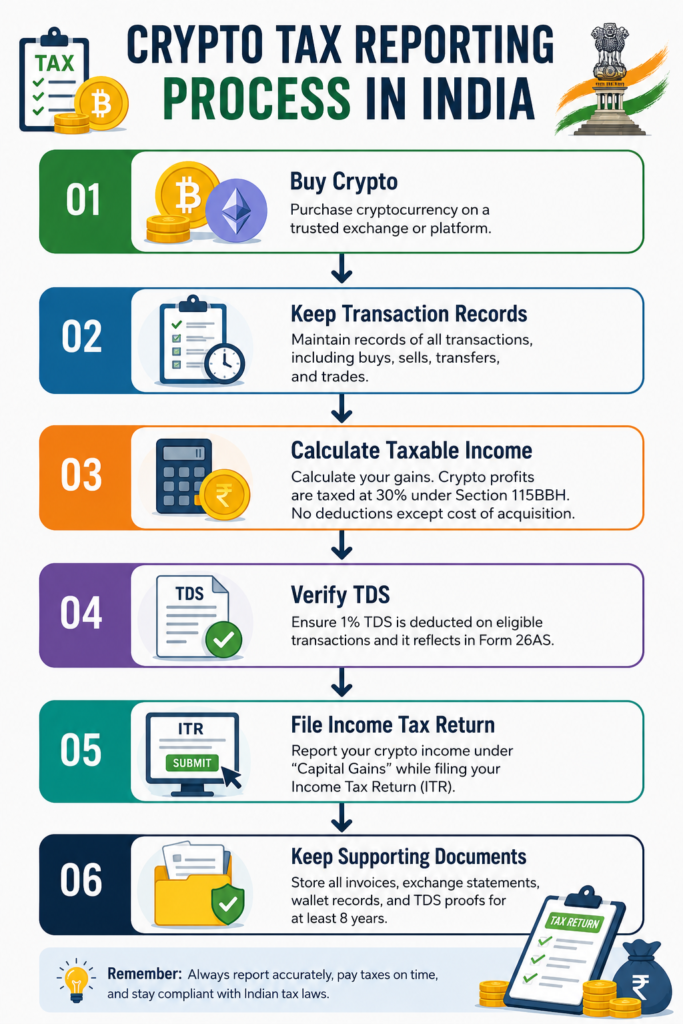
Crypto disclosure means accurately reporting your cryptocurrency-related income and transactions in your Income Tax Return (ITR), wherever required under applicable tax laws.
Disclosure may include:
- Profits from buying and selling cryptocurrencies
- Income from staking
- Mining rewards
- Airdrops
- NFT transactions
- Crypto received as gifts (subject to applicable provisions)
- Business income involving crypto
- Other taxable virtual digital asset transactions
The purpose of disclosure is to ensure that taxpayers correctly report taxable income and pay any tax due.
Is Crypto Disclosure Mandatory in India?
If you have taxable cryptocurrency income or transactions that are required to be reported under Indian tax laws, you should disclose them accurately in your Income Tax Return.
India introduced a specific tax framework for Virtual Digital Assets (VDAs), making crypto taxation much clearer than before. Investors should maintain proper records and report taxable transactions correctly.
Simply because tax has been deducted at source (TDS) does not necessarily mean that no further reporting is required. TDS is generally a reporting and tax collection mechanism and does not replace your obligation to file an accurate return where applicable.
What Are Virtual Digital Assets (VDAs)?
Under Indian tax law, Virtual Digital Assets generally include:
- Bitcoin
- Ethereum
- Solana
- XRP
- Cardano
- Dogecoin
- Meme coins
- Stablecoins
- NFTs
- Many other blockchain-based digital assets covered by the legal definition
The law may evolve over time, so investors should monitor official updates.
How Cryptocurrency Is Taxed in India
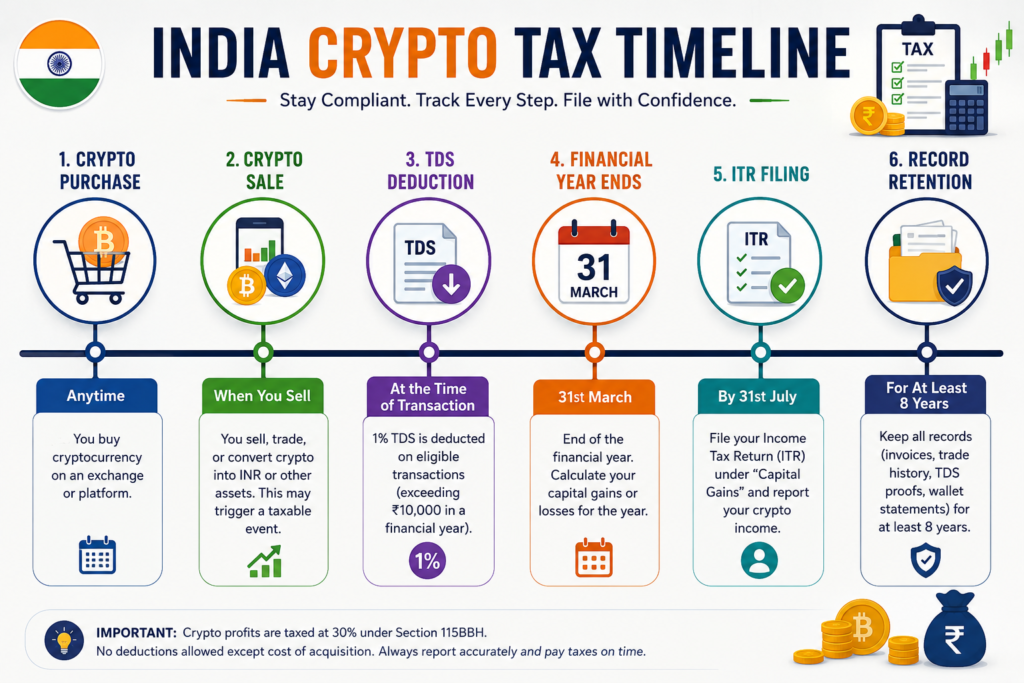
The taxation of crypto differs from traditional investments.
Generally, taxable profits from transferring qualifying virtual digital assets are subject to the tax regime prescribed under the Income-tax Act.
Investors should understand that:
- Each taxable transaction should be properly recorded.
- Supporting documentation should be retained.
- Applicable TDS provisions may apply in certain transactions.
- Income should be reported in the appropriate manner while filing the Income Tax Return.
Because tax treatment can vary depending on the facts and future legislative changes, taxpayers should verify the latest official guidance before filing.
Who Needs to Report Crypto Income?
You may need to report cryptocurrency-related income if you:
- Buy and sell crypto for profit.
- Trade frequently.
- Receive staking rewards.
- Earn mining income.
- Receive crypto through airdrops.
- Accept crypto as payment for services.
- Run a crypto-related business.
- Deal in NFTs.
- Have taxable gains from transferring digital assets.
Maintaining complete records throughout the year makes tax filing significantly easier.
Common Crypto Transactions That May Require Reporting
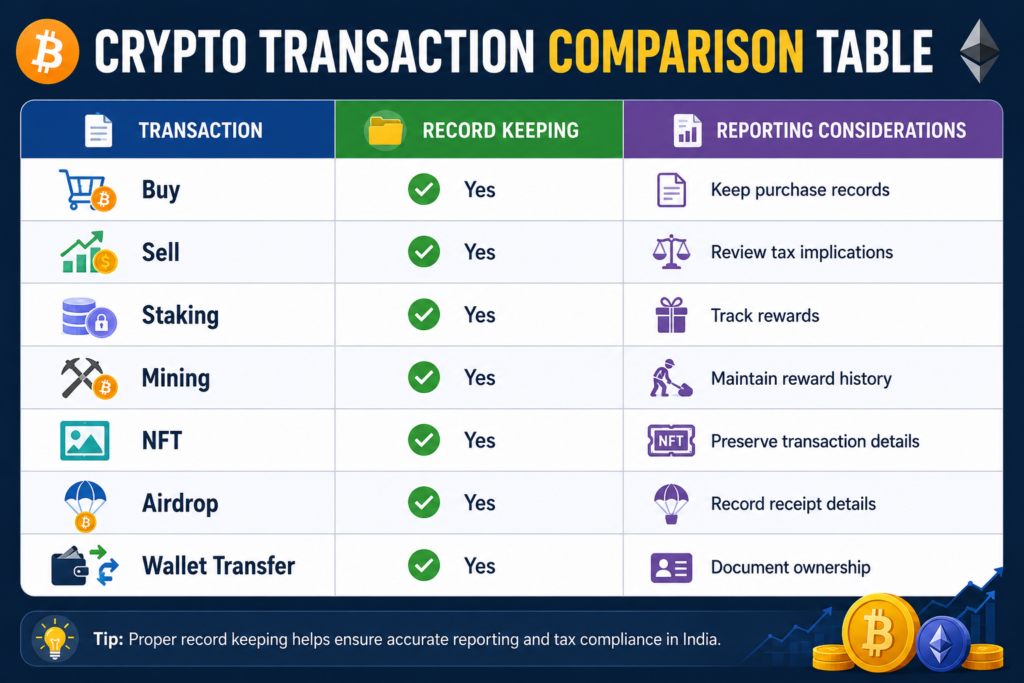
Buying Cryptocurrency
Purchasing cryptocurrency with no taxable event at the time of purchase generally does not create immediate taxable income. However, you should keep records of:
- Purchase date
- Purchase price
- Exchange used
- Transaction ID
- Wallet address (where applicable)
- Fees paid
These records help calculate gains or losses when a taxable transfer occurs.
Selling Cryptocurrency
Selling crypto for fiat currency may create taxable consequences depending on the applicable provisions of law.
Maintain:
- Sale value
- Purchase value
- Date of purchase
- Date of sale
- Exchange fees
- Net proceeds
Crypto-to-Crypto Swaps
Many investors overlook crypto-to-crypto swaps.
Depending on the applicable legal provisions and facts, exchanging one cryptocurrency for another may have tax implications. Proper documentation is essential.
Staking Rewards
Rewards earned from staking may have tax implications depending on the circumstances and prevailing law.
Keep records of:
- Date received
- Quantity received
- Fair market value
- Wallet information
Mining Rewards
Mining income may also have tax implications.
Maintain:
- Mining rewards
- Electricity expenses (where relevant)
- Hardware costs
- Wallet history
- Reward dates
Professional advice may be appropriate for large-scale mining activities.
Why Accurate Disclosure Matters
Accurate reporting offers several benefits:
- Reduces the risk of tax disputes.
- Makes responding to notices easier.
- Demonstrates good compliance practices.
- Creates a documented transaction history.
- Supports future financial planning.
Maintaining organized records and filing accurate returns is generally far less costly than dealing with corrections or disputes later.
Documents You Should Keep
Every crypto investor should maintain:
- Exchange statements
- Wallet transaction history
- Buy and sell confirmations
- Bank statements
- TDS certificates (where applicable)
- Income Tax Return copies
- Tax payment receipts
- Spreadsheet of all transactions
- CSV exports from exchanges
- Screenshots for complex transactions when needed
Good record-keeping is one of the most effective ways to simplify compliance and prepare for any future queries.
Potential Consequences of Not Disclosing Crypto Income in India
Many investors assume that if they use a foreign cryptocurrency exchange or transfer funds between wallets, the Income Tax Department cannot identify their transactions. This assumption can be risky.
The Indian tax system has become increasingly data-driven. Authorities use information from various reporting sources, financial institutions, and compliance requirements to identify inconsistencies between reported income and financial activity.
The exact consequences of non-disclosure depend on the facts of each case, the applicable provisions of the Income-tax Act, and whether the omission was genuine or intentional.
Can the Income Tax Department Detect Cryptocurrency Transactions?
While no detection system is perfect, tax authorities today have access to significantly more information than they did a few years ago.
Information may come from:
- Indian cryptocurrency exchanges
- TDS reporting
- Bank transaction analysis
- Income Tax Return data
- Financial Intelligence Unit (FIU) reporting where applicable
- Information sharing under legal and regulatory frameworks
- Data analytics used by tax authorities
This means that assuming crypto activity will remain permanently hidden is not a sound compliance strategy.
What Happens If You Don’t Report Crypto Income?
The outcome depends on the circumstances.
Possible consequences may include:
- A request for clarification from the Income Tax Department.
- Additional tax assessment.
- Interest on unpaid tax where applicable.
- Penalties under relevant provisions of tax law, depending on the facts.
- Increased scrutiny of future tax returns.
- Requirement to provide supporting documents and transaction records.
Not every mistake automatically results in the same consequence. Tax authorities generally evaluate each case based on the available evidence and applicable law.
Common Reasons Investors Receive Tax Notices
Many notices are triggered by inconsistencies rather than deliberate wrongdoing.
Examples include:
1. Large Bank Deposits
A taxpayer reports a modest annual income but receives significant deposits from crypto exchanges.
2. TDS Mismatch
TDS has been deducted on crypto transactions, but the related income is not reflected appropriately in the tax return.
3. High-Value Trading
Frequent high-value crypto trading with little or no corresponding disclosure.
4. Foreign Exchange Activity
Transactions involving overseas crypto platforms without appropriate reporting where required.
5. Mismatch Between Financial Records and Tax Return
The financial trail indicates cryptocurrency activity that is inconsistent with the filed return.
Interest on Unpaid Tax
If tax remains unpaid beyond the applicable due dates, interest may be charged according to the provisions of the Income-tax Act.
The amount depends on several factors, including:
- Tax due
- Filing date
- Payment date
- Relevant statutory provisions
Interest can substantially increase the total amount payable over time.
Under-Reporting vs. Misreporting
Indian tax law distinguishes between different types of reporting issues.
Under-Reporting
This generally refers to situations where taxable income has not been fully reported.
Examples may include:
- Forgetting to include certain crypto gains.
- Miscalculating taxable income.
- Missing some transactions due to poor record-keeping.
Misreporting
Misreporting generally involves more serious situations, such as providing incorrect information or concealing facts.
Examples may include:
- Using fabricated transaction values.
- Hiding exchange accounts.
- Providing false documentation.
- Deliberately omitting taxable crypto income.
The legal consequences differ depending on the specific facts and applicable provisions.
Can You Correct a Mistake?
In many situations, taxpayers may be able to correct genuine mistakes by taking timely action in accordance with the Income-tax Act.
Depending on the circumstances, this may involve:
- Filing or revising a return if permitted.
- Paying any additional tax due.
- Paying applicable interest.
- Maintaining proper supporting documentation.
If the issue is significant or involves complex crypto transactions, consulting a qualified tax professional is advisable.
How to Reduce the Risk of Compliance Issues
Following good compliance practices can significantly reduce the likelihood of problems later.
Maintain Complete Transaction Records
Keep a record of every:
- Purchase
- Sale
- Swap
- Transfer
- Staking reward
- Mining reward
- NFT transaction
- Airdrop
Do not rely solely on exchange history, as access to historical data may become limited.
Download Exchange Statements Regularly
At least once every month, download:
- Trade history
- Deposit history
- Withdrawal history
- Wallet balances
- Fee reports
- Transaction IDs
Store copies securely.
Keep Bank Records
Maintain records of:
- Deposits to exchanges
- Withdrawals from exchanges
- Payment confirmations
- UPI transactions
- Credit card payments used for crypto purchases
These documents help establish the source and movement of funds.
Track Every Wallet
Many investors forget about self-custody wallets.
Maintain a list of:
- Wallet addresses
- Network used
- Purpose of each wallet
- Transfer history
This helps explain wallet-to-wallet transfers if questions arise.
Crypto Compliance Checklist
Use this checklist before filing your Income Tax Return.
☐ Download exchange statements.
☐ Export wallet transaction history.
☐ Verify purchase prices.
☐ Calculate gains accurately.
☐ Check staking rewards.
☐ Review mining income.
☐ Review NFT transactions.
☐ Verify TDS details where applicable.
☐ Keep bank statements.
☐ Save tax calculations.
☐ Retain supporting documents.
☐ File your return before the due date.
Example Scenario
Rahul purchased cryptocurrency worth ₹2,00,000 during the financial year.
Later, he sold part of his holdings through a registered exchange and received funds in his bank account. TDS was deducted where applicable.
If Rahul reports the transaction correctly, pays any tax due, and maintains proper records, his compliance process is straightforward.
If Rahul ignores the transaction and does not disclose taxable income, he may later need to explain the mismatch between exchange activity, bank transactions, and his tax return. Depending on the facts and the applicable law, additional tax, interest, or penalties could arise.
Common Mistakes Crypto Investors Make
Many investors unintentionally create tax problems because they:
- Assume small profits do not need reporting.
- Forget transactions on old exchanges.
- Ignore staking rewards.
- Fail to download transaction history.
- Lose wallet records.
- Miss crypto-to-crypto swaps.
- Rely only on exchange profit reports.
- Forget about TDS reconciliation.
- Delay filing returns.
- Ignore notices from the Income Tax Department.
Avoiding these mistakes can save considerable time and expense.
Best Practices for Long-Term Compliance
Experienced investors typically follow these habits:
- Update records after every trade.
- Use portfolio tracking software.
- Maintain separate folders for each financial year.
- Preserve invoices and confirmations.
- Reconcile exchange statements with bank statements.
- Review tax obligations before the return filing deadline.
- Seek professional advice for complex transactions involving DeFi, cross-chain bridges, derivatives, or foreign exchanges.
How to Report Cryptocurrency in Your Income Tax Return (ITR)
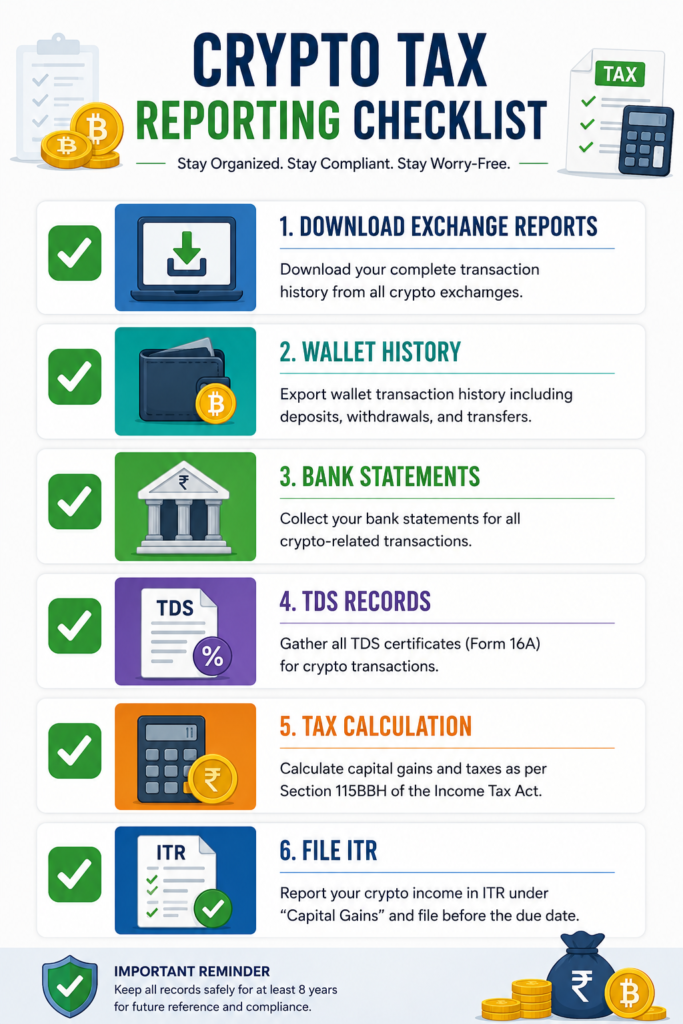
One of the most common questions among Indian crypto investors is how to correctly report cryptocurrency transactions while filing an Income Tax Return (ITR). Accurate reporting helps reduce the risk of errors, notices, and unnecessary disputes.
Although the Income Tax Department periodically updates return forms and reporting requirements, the general approach remains the same: maintain complete records, calculate taxable income correctly, and disclose all required information.
This section explains the process step by step.
Step 1: Collect All Crypto Transaction Records
Before starting your Income Tax Return, gather every document related to your cryptocurrency activity during the financial year.
Your records should include:
- Purchase history
- Sale history
- Deposit history
- Withdrawal history
- Wallet transfers
- Exchange statements
- Trading reports
- Bank statements
- UPI payment records
- Credit card payment records (if used)
- TDS details where applicable
- Transaction fees
- Gas fees
- Wallet addresses
- Blockchain transaction IDs
Many investors use multiple exchanges. Ensure you collect records from every platform you used.
Step 2: Download Trade Reports
Most cryptocurrency exchanges allow users to download transaction history in CSV or Excel format.
Download:
- Spot trades
- Futures reports (if applicable)
- Margin trades
- Earn products
- Staking history
- Savings products
- P2P transactions
- Deposit reports
- Withdrawal reports
Do not rely solely on your account dashboard because historical data may not remain available indefinitely.
Step 3: Organize Transactions
Create a spreadsheet with columns such as:
| Date | Coin | Buy Price | Sell Price | Quantity | Exchange | Fees | Notes |
|---|
This makes tax calculation much easier.
Step 4: Calculate Taxable Transactions
Review every transaction individually.
Examples include:
Buying Crypto
Buying cryptocurrency generally does not create taxable income at the time of purchase. However, you should preserve purchase records because they are needed when calculating gains on a later taxable transfer.
Selling Crypto
Selling cryptocurrency may create taxable income depending on the applicable provisions.
Record:
- Purchase cost
- Selling price
- Date
- Quantity
- Exchange fees
Crypto-to-Crypto Trading
Many investors mistakenly ignore crypto swaps.
For example:
Bitcoin → Ethereum
Ethereum → Solana
Solana → XRP
Each transaction should be reviewed carefully because tax implications may arise under applicable law.
Step 5: Review Staking Income
If you received rewards from staking, maintain records of:
- Date received
- Coin
- Quantity
- Market value at receipt
- Wallet address
These records help support your reporting if required.
Step 6: Review Mining Rewards
Mining records should include:
- Coins mined
- Date received
- Market value
- Equipment costs
- Electricity records (where relevant)
- Mining software reports
Large-scale mining activities may require professional tax advice.
Step 7: Review NFT Transactions
If you purchased or sold NFTs during the financial year, retain:
- Purchase invoices
- Sale receipts
- Wallet addresses
- Marketplace confirmations
- Transaction hashes
- Royalty income records (if applicable)
Step 8: Verify TDS Information
Where applicable, compare the TDS reflected in your records with your tax information to ensure consistency.
Keep copies of:
- Exchange statements
- TDS certificates (if issued)
- Payment records
Any mismatch should be investigated before filing your return.
Example of a Crypto Transaction Record
| Transaction | Value |
| Purchased Bitcoin | ₹1,50,000 |
| Sold Bitcoin | ₹2,20,000 |
| Exchange Fee | ₹1,000 |
| Net Sale Amount | ₹2,19,000 |
This type of documentation makes it easier to calculate and support your reported figures.
Example Portfolio
Suppose an investor made the following transactions during the financial year.
| Coin | Activity |
| Bitcoin | Buy and Sell |
| Ethereum | Staking |
| Solana | Spot Trading |
| XRP | Long-Term Holding |
| Dogecoin | Airdrop |
| Polygon | Wallet Transfer |
Every activity should be reviewed individually because the tax treatment may differ.
Wallet Transfers
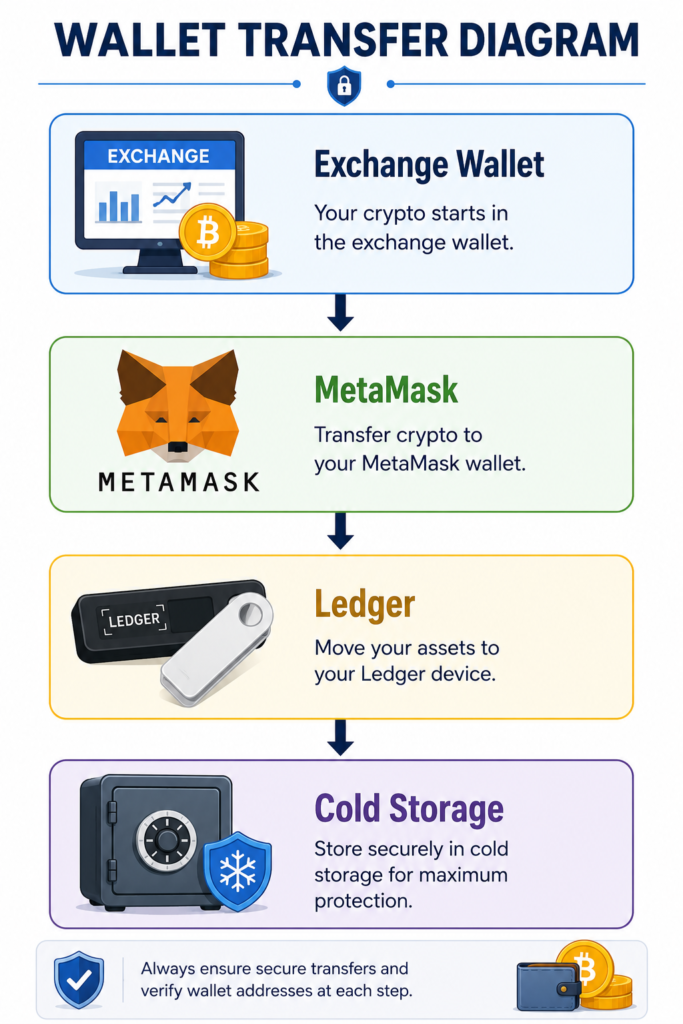
Many investors panic when moving cryptocurrency between their own wallets.
Example:
Exchange Wallet
↓
Hardware Wallet
↓
Mobile Wallet
↓
Cold Storage
A transfer between wallets owned by the same person generally differs from a sale, but maintaining documentation helps demonstrate the nature of the transaction if questions arise.
Foreign Exchanges
Many Indian investors use international exchanges.
Regardless of where transactions occur, you should maintain:
- Complete trade history
- Deposit records
- Withdrawal records
- Wallet history
- Exchange account statements
- Fee reports
Cross-border activity can make record-keeping more important.
Airdrops
If you receive cryptocurrency through promotional campaigns or community rewards, maintain:
- Date received
- Token name
- Quantity
- Wallet address
- Fair market value at the time of receipt (where relevant)
Hard Forks
Blockchain networks occasionally split into two chains.
If you receive new tokens because of a hard fork, retain:
- Blockchain announcement
- Wallet records
- Quantity received
- Date
- Market value (if relevant)
Gifts
If you receive cryptocurrency as a gift, keep:
- Gift confirmation
- Sender details (where available)
- Date
- Wallet address
- Approximate value at the time of receipt
The tax treatment of gifts depends on the applicable legal provisions and circumstances.
Record Retention
Good record-keeping is one of the strongest defenses in the event of a tax query.
Keep copies of:
- Income Tax Returns
- Crypto spreadsheets
- Wallet exports
- Exchange reports
- CSV downloads
- Screenshots of important transactions
- Bank statements
- Payment confirmations
Back up these files securely using encrypted cloud storage or an external drive.
Recommended Annual Crypto Tax Review
Before filing your return each year, ask yourself:
- Have I downloaded all exchange reports?
- Have I included every wallet?
- Have I reviewed staking rewards?
- Have I checked mining income?
- Have I reviewed NFT activity?
- Have I reconciled my bank statements?
- Have I reviewed TDS where applicable?
- Have I kept proof of every major transaction?
Completing this review each year can help identify missing information before filing.
Common Filing Errors
Avoid these mistakes:
- Forgetting an old exchange account.
- Ignoring wallet transfers in your records.
- Losing CSV reports.
- Using incorrect purchase prices.
- Failing to reconcile exchange data with bank statements.
- Omitting staking or airdrop records.
- Waiting until the filing deadline to organize documents.
Why Accurate Documentation Matters
Well-organized records can:
- Simplify tax preparation.
- Reduce the chance of calculation errors.
- Help answer queries from tax authorities.
- Make future portfolio tracking easier.
- Save time during audits or reviews.
Investing a few hours each month in maintaining records is usually far easier than reconstructing years of transaction history later.
Advanced Crypto Tax Situations Every Indian Investor Should Understand
Once you understand the basics of cryptocurrency taxation, the next step is learning how more complex transactions may affect your tax reporting. Many investors today do far more than simply buy and sell Bitcoin. They participate in decentralized finance (DeFi), staking, NFTs, futures trading, liquidity pools, and international exchanges.
Each of these activities requires careful record-keeping.
DeFi Transactions
Decentralized Finance (DeFi) allows investors to lend, borrow, swap, and earn rewards without traditional financial intermediaries.
Popular DeFi activities include:
- Lending crypto
- Borrowing crypto
- Liquidity pools
- Yield farming
- Token swaps
- Cross-chain bridges
These transactions can generate hundreds of blockchain entries during a single month.
Many investors mistakenly believe that because these transactions occur on decentralized protocols, they do not need to maintain records.
This is incorrect.
For every DeFi transaction, you should retain:
- Date
- Blockchain network
- Wallet address
- Token received
- Token transferred
- Transaction hash
- Gas fee
- Market value where relevant
Yield Farming
Yield farming involves depositing digital assets into liquidity protocols in exchange for rewards.
Keep records of:
- Initial deposit
- Reward tokens received
- Withdrawal amount
- Platform used
- Wallet used
Liquidity Pools
Liquidity pools involve contributing assets to decentralized exchanges.
Maintain records of:
- Tokens deposited
- Pool share received
- Rewards earned
- Withdrawal transactions
- Impermanent loss calculations (for investment analysis)
NFT Transactions
NFT investors should maintain documentation for every purchase and sale.
Your records should include:
- NFT name
- Marketplace
- Collection
- Purchase price
- Sale price
- Wallet address
- Blockchain network
- Creator royalties (if applicable)
Crypto Futures Trading
Thousands of Indian traders actively use crypto futures.
Unlike simple spot investing, futures trading generates many transactions every day.
Maintain:
- Entry price
- Exit price
- Position size
- Leverage
- Funding fees
- Trading fees
- Profit and loss reports
Download monthly reports from your exchange rather than waiting until the end of the financial year.
Margin Trading
Margin trading creates additional complexity because borrowed funds are involved.
Keep records of:
- Borrowed amount
- Interest paid
- Trade history
- Liquidation events
- Repayments
Foreign Crypto Exchanges
Many Indian investors use overseas platforms.
Examples include exchanges operating outside India.
Regardless of where you trade, maintain complete records of:
- Account statements
- Deposit history
- Withdrawal history
- Wallet transfers
- Trading reports
- Identity verification documents
- Monthly balance reports
Using a foreign exchange does not remove the need to comply with Indian tax laws.
Hardware Wallets
Many long-term investors store cryptocurrency in hardware wallets.
Maintain:
- Wallet address
- Purchase records
- Transfer records
- Backup phrase storage (offline and secure)
- Transaction history
Stablecoins
Transactions involving stablecoins should also be recorded.
Examples include:
- Buying stablecoins
- Selling stablecoins
- Swapping stablecoins
- Using stablecoins for payments
Meme Coins
Even small-value meme coin trades should be included in your annual records.
Do not ignore transactions simply because the amounts seem insignificant.
Crypto Received as Salary
Some freelancers and remote workers receive payment in cryptocurrency.
Maintain:
- Invoice
- Payment date
- Token received
- Quantity
- Fair market value on receipt
- Client details
- Wallet transaction ID
Business Accepting Crypto
Businesses that accept cryptocurrency should maintain additional records, including:
- Customer invoices
- Wallet addresses
- Payment confirmations
- Accounting entries
- Bank conversion records (where applicable)
Professional accounting advice is recommended for businesses with significant crypto activity.
Best Practices for Serious Crypto Investors
Professional investors usually follow a disciplined compliance process.
Monthly Record Review
At the end of each month:
- Download exchange reports.
- Export wallet history.
- Reconcile balances.
- Update your spreadsheet.
- Save backups.
Waiting until the tax filing deadline often leads to missing information.
Quarterly Portfolio Review
Every three months:
- Review unrealized holdings.
- Verify transaction history.
- Confirm exchange balances.
- Check wallet balances.
- Archive reports securely.
Annual Tax Preparation
Before filing your Income Tax Return:
- Review every exchange account.
- Review every wallet.
- Verify transaction history.
- Check TDS records where applicable.
- Prepare supporting documentation.
Case Study 1
Aman purchased Bitcoin for ₹3,00,000.
Six months later, he exchanged part of his Bitcoin for Ethereum.
Later, he sold the Ethereum and transferred the proceeds to his bank account.
Because Aman maintained detailed records of every transaction, preparing his tax return took only a few hours.
Case Study 2
Riya traded on three different exchanges.
She completed over 2,000 trades during the financial year but never downloaded her reports.
One exchange later restricted access to older trade history, making it difficult to reconstruct her records.
She ultimately spent weeks recreating transactions from blockchain explorers and bank statements.
This illustrates why downloading reports regularly is a simple but valuable habit.
Common Myths About Crypto Tax
Myth 1: “Crypto is anonymous.”
Blockchain transactions are publicly recorded, and reporting obligations for exchanges have expanded significantly under India’s evolving compliance framework.
Myth 2: “Foreign exchanges cannot be traced.”
International information-sharing standards and expanded reporting requirements continue to increase transparency. Trading through an overseas platform does not automatically remove Indian tax obligations.
Myth 3: “Small trades don’t matter.”
Many small transactions can add up over a financial year. Good record-keeping is important regardless of trade size.
Myth 4: “TDS means I don’t need to report crypto.”
A 1% TDS is generally a tax collection mechanism. It does not replace the requirement to accurately report taxable crypto transactions in your Income Tax Return where applicable.
Expert Tips
- Maintain one master spreadsheet for every financial year.
- Download exchange reports monthly.
- Label transfers between your own wallets clearly.
- Store transaction IDs and supporting documents securely.
- Keep backups of all CSV files.
- Review your records before the ITR filing deadline rather than at the last minute.
- If your crypto activity includes DeFi, derivatives, cross-chain transactions, or high trading volumes, consider consulting a qualified tax professional.
Frequently Asked Questions (FAQs)
The following questions are designed to answer the most common concerns of Indian cryptocurrency investors while also helping this article rank for long-tail search queries.
1. Is crypto disclosure mandatory in India?
If you have taxable cryptocurrency transactions or income that must be reported under the Income-tax Act, you should disclose them correctly in your Income Tax Return (ITR). Maintaining accurate records and filing complete returns helps reduce compliance risks.
2. What happens if I don’t disclose my crypto income?
Depending on the facts of your case, non-disclosure may result in additional tax demands, applicable interest, penalties under relevant provisions of the Income-tax Act, or notices seeking clarification. The outcome depends on the nature of the omission and the applicable law.
3. Can the Income Tax Department track cryptocurrency?
The Income Tax Department receives information from multiple sources, including reporting mechanisms, financial institutions, and data analytics. As India’s crypto reporting framework continues to evolve, authorities have greater visibility into cryptocurrency transactions than in previous years.
4. Does using a foreign exchange avoid Indian taxes?
No.
If you are an Indian tax resident, your tax obligations generally depend on Indian tax laws rather than the location of the exchange you use.
5. Is Bitcoin taxable in India?
Bitcoin falls within the definition of a Virtual Digital Asset (VDA) under Indian tax law, and taxable transactions involving Bitcoin are generally subject to the applicable provisions of the Income-tax Act.
6. Is Ethereum taxable?
Yes. Like Bitcoin, Ethereum is generally treated as a Virtual Digital Asset under the current tax framework.
7. Are meme coins taxable?
Yes. Tax treatment generally depends on the nature of the transaction rather than the popularity of the token.
8. Are NFTs taxable?
NFTs may also fall within India’s VDA framework, depending on the applicable legal provisions and the nature of the transaction.
9. Do I need to report staking rewards?
If staking rewards are taxable under the applicable provisions, they should be reported appropriately. Keep detailed records of reward dates, quantities, and values.
10. Are wallet transfers taxable?
Transfers between wallets owned by the same person are generally different from a sale. However, you should keep records to demonstrate that ownership did not change.
11. What records should I keep?
Maintain:
- Exchange statements
- Wallet history
- Bank statements
- Trade confirmations
- CSV reports
- Transaction IDs
- Tax calculations
- TDS records (where applicable)
12. How long should I keep crypto records?
Maintain your records for several years in accordance with applicable tax and record-retention requirements. Digital backups are highly recommended.
13. Can I revise my Income Tax Return?
If the law permits and the applicable deadlines have not passed, you may be able to revise your return to correct genuine mistakes. Check the latest Income Tax Department guidance or consult a qualified tax professional.
14. Should I hire a Chartered Accountant?
If your crypto activity involves high transaction volumes, DeFi, NFTs, foreign exchanges, or business income, professional advice can help ensure accurate reporting.
15. Is crypto mining taxable?
Mining-related tax treatment depends on the applicable provisions and the facts of each case. Maintain complete records of rewards, dates, and associated documentation.
16. Is crypto received as salary taxable?
Cryptocurrency received in exchange for services may have tax implications. Keep invoices, payment confirmations, and valuation records.
17. What if I forgot an old exchange account?
Recover the transaction history as soon as possible and include any required information in your records. Ignoring old accounts can create reporting gaps.
18. Do I need to report small profits?
Tax obligations are determined by law, not by whether an investor considers the amount “small.” Review all transactions before filing your return.
19. Can I file my own crypto taxes?
Many investors with straightforward transactions prepare their own returns. More complex portfolios may benefit from professional assistance.
20. What is the biggest mistake crypto investors make?
Poor record-keeping.
Most compliance problems arise because investors cannot reconstruct years of transaction history accurately.
Final Crypto Compliance Checklist
Before filing your Income Tax Return, complete the following checklist:
✓ Download all exchange statements.
✓ Export wallet transaction history.
✓ Verify every purchase and sale.
✓ Review staking rewards.
✓ Review mining activity.
✓ Review NFT transactions.
✓ Check crypto received as gifts.
✓ Verify TDS details where applicable.
✓ Reconcile bank statements.
✓ Save all transaction IDs.
✓ Organize supporting documents.
✓ Back up all records securely.
✓ Review calculations carefully.
✓ File your return before the due date.
Key Takeaways
If you remember only a few things from this guide, make them these:
- Report taxable crypto transactions accurately.
- Keep complete records throughout the year.
- Download exchange reports regularly.
- Do not ignore transactions on foreign exchanges.
- Reconcile your records before filing.
- Respond promptly to any communication from the Income Tax Department.
- Seek professional advice for complex situations.
Good compliance is much easier than correcting mistakes later.
Conclusion
Cryptocurrency has transformed investing in India, but it has also introduced new tax and reporting responsibilities. As the regulatory framework continues to evolve, maintaining accurate records and understanding your obligations is becoming increasingly important.
Whether you are a long-term Bitcoin investor, an active trader, an NFT collector, or a DeFi participant, good documentation is your strongest safeguard. Regularly downloading exchange reports, organizing wallet records, and filing an accurate Income Tax Return can help reduce the likelihood of disputes and make tax compliance much simpler.
Instead of viewing crypto tax reporting as an annual burden, treat it as part of responsible investing. Spending a small amount of time each month maintaining your records can save countless hours during tax season and provide greater confidence that your reporting is complete.
By following the practices outlined in this guide, you will be better prepared to navigate India’s crypto tax landscape while keeping your investments organized for the future.
Frequently Used Terms
| Term | Meaning |
|---|---|
| VDA | Virtual Digital Asset |
| ITR | Income Tax Return |
| TDS | Tax Deducted at Source |
| DeFi | Decentralized Finance |
| NFT | Non-Fungible Token |
| CSV | Comma-Separated Values export of transaction history |
| Wallet Address | Public blockchain address used to send or receive crypto |
| Transaction Hash | Unique blockchain identifier for a transaction |
Natalie Kingsley is the lead author and primary contributor at Fundznests.com. She is passionate about financial education and dedicated to helping readers build confidence in managing their money, growing their wealth, and achieving long-term financial goals.
With a strong interest in personal finance, investing, retirement planning, and wealth-building strategies, Natalie creates informative and practical content designed for both beginners and experienced investors. Her writing focuses on breaking down complex financial concepts into clear, actionable insights that readers can apply to their everyday financial lives.