
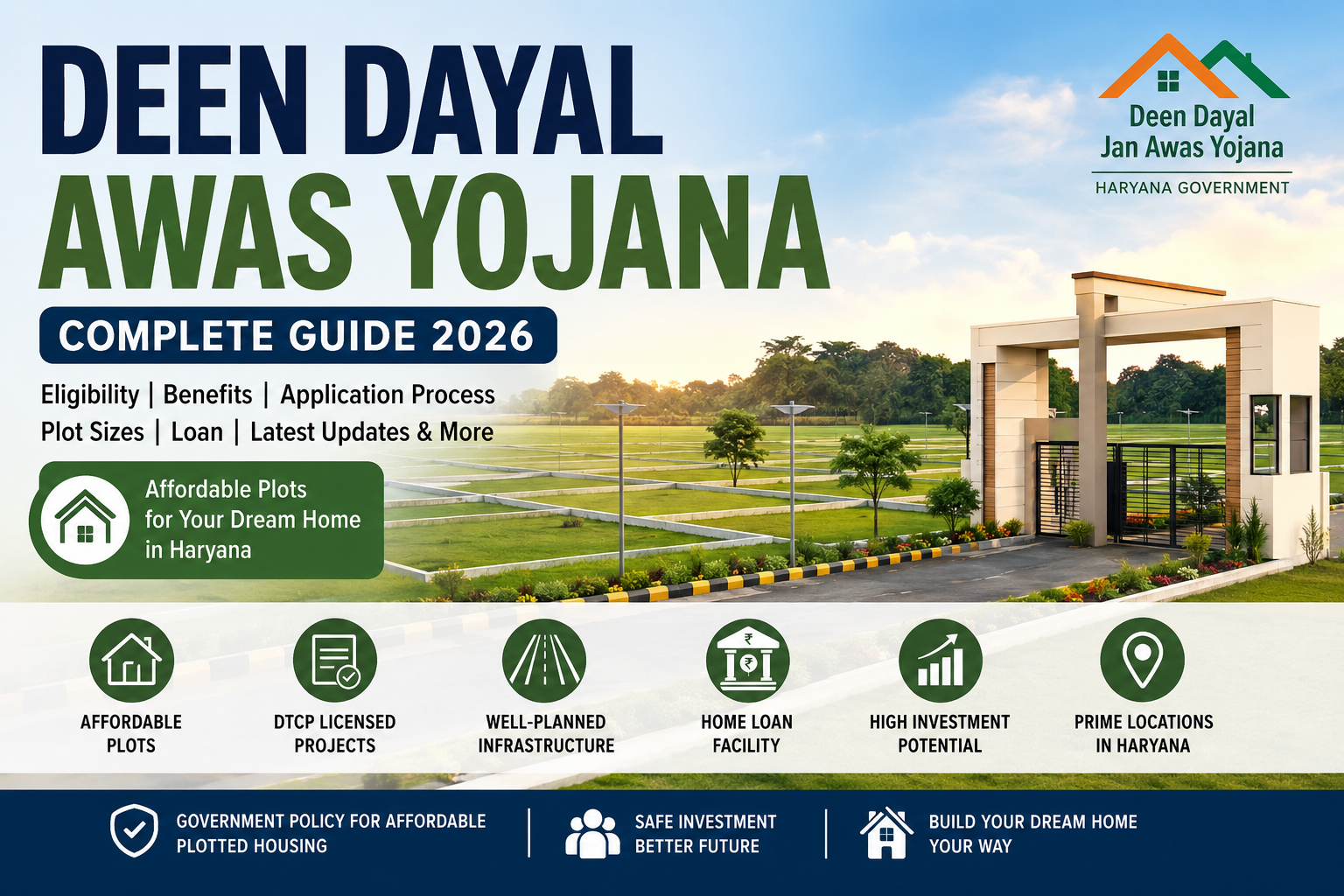
Buying a home is one of the biggest financial goals for most families. However, rising property prices make it difficult for many middle-income and first-time buyers to own residential land. To encourage affordable plotted housing, the Haryana Government introduced the Deen Dayal Jan Awas Yojana (DDJAY), also commonly searched as Deen Dayal Awas Yojna.
The scheme focuses on developing planned, low-rise residential colonies in selected towns across Haryana. Instead of high-rise apartments, it promotes affordable residential plots with basic infrastructure, allowing buyers to build homes according to approved building norms. The policy aims to expand housing opportunities while encouraging planned urban development and reducing the growth of unauthorized colonies.
Whether you are planning to buy your first plot, invest in Haryana’s growing real estate market, or simply want to understand how deen dayal awas yojna works, this guide explains everything in simple language.
What Is Deen Dayal Awas Yojna?
The Deen Dayal Jan Awas Yojana (DDJAY) is an affordable plotted housing policy launched by the Haryana Government in 2016. The scheme is designed to promote the development of licensed residential colonies in low- and medium-potential towns across Haryana.
Unlike many housing schemes that provide ready-built apartments, deen dayal awas yojna focuses on freehold residential plots within approved colonies. Buyers can construct their homes according to applicable building regulations after purchasing the plot.
The policy encourages private developers to develop licensed colonies with roads, drainage, water supply, parks, electricity, and other essential infrastructure under the supervision of the state’s planning authorities.
Why Was the Scheme Introduced?
Before the launch of deen dayal awas yojna, many towns experienced rapid growth without proper planning. Unauthorized colonies often lacked roads, drainage systems, parks, and basic civic amenities.
To address these challenges, the Haryana Government introduced deen dayal awas yojna with several objectives:
- Promote affordable housing.
- Encourage planned urban expansion.
- Reduce unauthorized residential colonies.
- Increase home ownership opportunities.
- Support infrastructure development.
- Encourage investment in smaller towns.
- Create sustainable residential communities.
The policy also complements the broader goal of improving access to affordable housing through regulated development.
Objectives of Deen Dayal Jan Awas Yojana
The scheme has several long-term objectives.
1. Affordable Housing
One of the primary goals is to make residential plots more accessible for middle-income and eligible buyers by encouraging affordable plotted developments.
2. Planned Development
Instead of unplanned settlements, DDJAY supports licensed residential colonies with proper roads, drainage, parks, street lighting, and utility infrastructure.
3. Better Infrastructure
Licensed projects are expected to include essential civic facilities, improving the quality of life for residents.
4. Encourage Private Investment
The policy encourages licensed private developers to participate in affordable housing development while complying with state planning norms.
5. Balanced Urban Growth
By promoting development in low- and medium-potential towns, the scheme helps distribute urban growth more evenly across Haryana instead of concentrating it only in major cities.
Key Features of Deen Dayal Awas Yojna
The scheme offers several features that distinguish it from traditional real estate projects.
| Feature | Details |
|---|---|
| Scheme Name | Deen Dayal Jan Awas Yojana (DDJAY) |
| State | Haryana |
| Launched | 2016 |
| Objective | Affordable plotted housing |
| Development Type | Licensed residential colonies |
| Colony Size | Generally 5–15 acres under the policy |
| Housing Type | Residential plots |
| Target Areas | Low and medium potential towns |
| Regulatory Authority | Department of Town & Country Planning, Haryana |
The official policy provides the framework for licensing, infrastructure standards, and development norms.
How Does Deen Dayal Awas Yojna Work?
Unlike apartment-based affordable housing schemes, DDJAY follows a plotted development model.
The process generally works as follows:
- A developer obtains the required license from the Haryana authorities.
- The colony is planned according to the deen dayal awas yojna policy.
- Infrastructure such as roads, water supply, sewerage, parks, and electricity is developed.
- Residential plots are offered for sale.
- Buyers register the property and construct homes according to approved building regulations.
Before purchasing any plot, buyers should verify that the project has the necessary approvals and licenses from the Department of Town & Country Planning, Haryana.
Who Can Benefit from the Deen Dayal Awas Yojna?
The scheme is useful for different categories of buyers.
First-Time Home Buyers
People looking to build their first home may find plotted developments more flexible than buying a ready-made apartment.
Middle-Income Families
DDJAY aims to improve access to residential plots at comparatively affordable prices in approved developments.
Investors
Many investors consider deen dayal awas yojna projects because of improving infrastructure and urban expansion in several Haryana towns. However, returns depend on location, project quality, market conditions, and regulatory approvals.
Working Professionals
Professionals employed in Gurugram, Faridabad, Sonipat, Panipat, Karnal, and nearby regions often explore deen dayal awas yojna projects in surrounding towns where land prices may be comparatively lower.
Advantages of Buying a Deen Dayal Awas Yojna Plot
Some commonly cited advantages include:
- Freehold ownership.
- Planned colony infrastructure.
- Licensed development.
- Scope to build a customized home.
- Potential long-term appreciation depending on location.
- Financing options may be available through eligible lenders for approved projects.
- Better legal clarity compared with unauthorized colonies, provided the project has valid approvals.
Important Points to Remember
While deen dayal awas yojna offers opportunities, buyers should keep these precautions in mind:
- Verify the developer’s license.
- Check project approvals.
- Confirm RERA registration where applicable.
- Review payment terms carefully.
- Visit the project site before booking.
- Consult a legal professional if needed.
- Do not rely solely on marketing material.
Taking these steps can help reduce the risk associated with any property purchase.
Is Deen Dayal Awas Yojna a Good Investment?
The answer depends on your financial goals.
For end users, deen dayal awas yojna provides an opportunity to purchase residential plots in planned developments instead of unauthorized colonies.
For investors, appreciation depends on factors such as:
- Project location
- Infrastructure development
- Connectivity
- Employment growth
- Future demand
- Regulatory compliance
Like any real estate investment, there is no guarantee of returns. Buyers should perform independent due diligence before investing.
What Makes DDJAY Different?
Compared with many traditional plotted developments, deen dayal awas yojna projects are developed under a specific Haryana Government policy with defined planning norms for licensed colonies. However, the quality of execution can vary between developers, making project verification essential.
Who Is Eligible for Deen Dayal Awas Yojna?
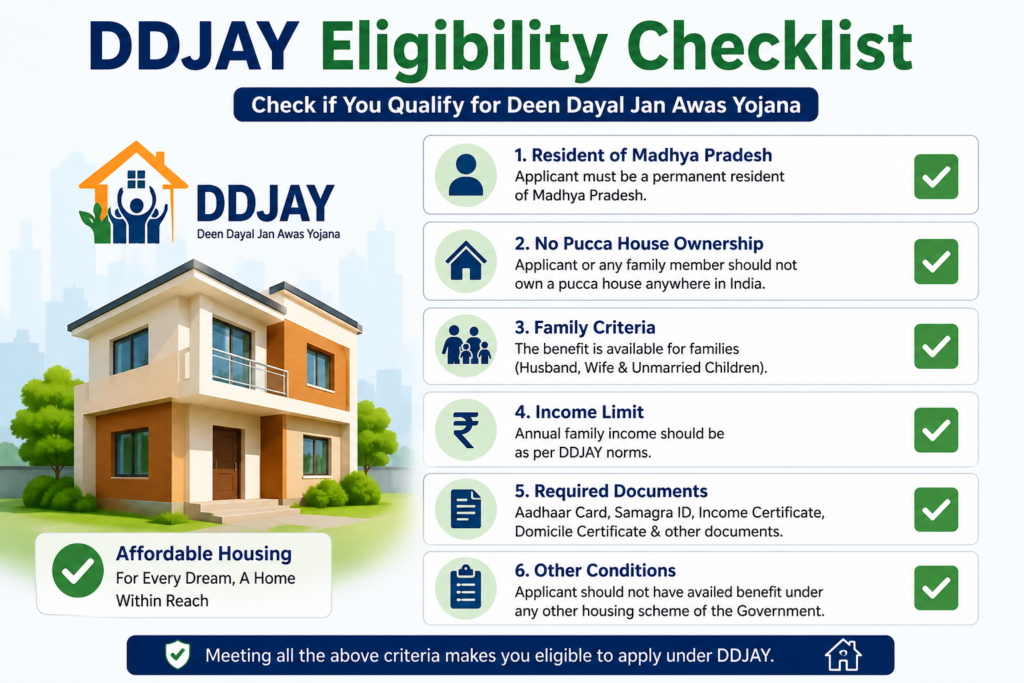
One of the most common questions people ask is whether they are eligible to purchase a plot under the Deen Dayal Jan Awas Yojana (DDJAY).
It is important to understand that Deen dayal awas yojna is primarily a development policy under which licensed developers create affordable plotted colonies. Eligibility for purchasing a plot may vary depending on the developer’s allotment conditions, financing requirements, and applicable government rules. Always check the eligibility criteria mentioned in the specific project brochure and verify the project’s approvals before applying.
Generally, the following applicants may be eligible.
1. Indian Citizens
Most DDJAY projects are open to Indian citizens who meet the developer’s requirements.
2. Adults
Applicants should generally be at least 18 years of age at the time of application or property registration.
3. Individual Buyers
Individuals can purchase plots either independently or jointly with family members, subject to the developer’s terms.
4. Salaried Professionals
Private sector employees often choose deen dayal awas yojna plots because they can obtain housing finance from banks for approved projects.
5. Business Owners
Self-employed individuals and business owners may also apply, provided they satisfy the lender’s income requirements if financing is needed.
6. NRIs
Some developers permit Non-Resident Indians (NRIs) to purchase plots in accordance with Indian property laws and RBI guidelines. Buyers should confirm the rules with the developer before proceeding.
Who Should Consider Buying a Deen Dayal Awas Yojna Plot?
Deen dayal awas yojna is suitable for several types of buyers.
First-Time Home Buyers
Instead of buying a ready-built apartment, many families prefer purchasing a residential plot and constructing their dream home in phases.
Long-Term Investors
Plots in developing locations may appreciate over time if infrastructure improves and demand increases. However, appreciation is not guaranteed and depends on market conditions.
Families
Families looking for low-rise communities often prefer plotted developments because they provide greater privacy and flexibility.
Retired Individuals
Many retirees choose plotted housing to build customized homes with future expansion options.
Benefits of Deen Dayal Awas Yojna
The popularity of deen dayal awas yojna has increased because it offers several advantages compared to conventional residential projects.
Affordable Residential Plots
The scheme encourages affordable plotted developments, making home ownership more accessible in eligible Haryana towns.
Planned Infrastructure
Licensed colonies generally include:
- Internal roads
- Water supply
- Sewerage systems
- Electricity
- Street lighting
- Parks
- Green areas
The exact amenities vary by project.
Legal Approvals
Projects developed under the DDJAY policy require approvals from the Department of Town and Country Planning (DTCP), Haryana. Buyers should still verify the project’s license and approvals independently before making any payment.
Flexibility to Build
Unlike apartments, buyers can design and construct their own homes while complying with applicable building regulations.
Potential for Value Appreciation
Property values may increase as surrounding infrastructure develops, though returns depend on location, market demand, and project quality.
Better Connectivity
Many DDJAY projects are located near:
- Highways
- Industrial corridors
- Metro expansion zones
- Employment hubs
- Schools
- Hospitals
- Shopping centres
Documents Required
Although documentation requirements may vary between projects, buyers are commonly asked to provide:
Identity Proof
- Aadhaar Card
- PAN Card
- Passport (if applicable)
Address Proof
- Aadhaar
- Voter ID
- Passport
- Driving Licence
- Utility Bill (where accepted)
Financial Documents
- Salary slips
- Income Tax Returns
- Bank statements
- Form 16 (if applicable)
Photographs
Recent passport-size photographs.
Contact Details
- Mobile number
- Email address
Additional Documents (if required)
- Marriage certificate (for joint applications)
- Power of Attorney (where applicable)
- NRI documents (if applicable)
Developers or lenders may request additional documents depending on the project or financing arrangement.
Plot Sizes Under Deen Dayal Awas Yojna
One of the biggest attractions of the scheme is the availability of different plot sizes to suit various budgets.
While the policy framework specifies planning norms in square metres, projects commonly market plots in square yards.
| Plot Size | Suitable For |
|---|---|
| 60 sq. m (approx. 72 sq. yd.) | Compact homes |
| 90 sq. yd. | Small families |
| 120 sq. yd. | Medium-sized homes |
| 150 sq. yd. | Larger independent houses |
| Up to 150 sq. m (approx. 179 sq. yd.) | Premium plotted homes |
Actual sizes available depend on the licensed project and developer.
Cities Where Deen Dayal Awas Yojna Projects Are Commonly Found
Several towns and cities in Haryana have DDJAY developments or licensed plotted projects, including:
- Gurugram (selected sectors and surrounding areas)
- Sohna
- Sonipat
- Panipat
- Karnal
- Bahadurgarh
- Jhajjar
- Rohtak
- Rewari
- Palwal
- Kurukshetra
- Yamunanagar
The availability of projects changes over time, so buyers should verify current licensed projects through official sources or the respective developer before booking.
Why Are Deen Dayal Awas Yojna Projects Becoming Popular?
Several factors have contributed to their growing demand.
Rising Apartment Prices
Property prices in major cities have increased significantly, leading many buyers to consider plotted developments in nearby towns.
Freedom of Construction
Owners can build homes according to their needs and future family requirements, subject to local building rules.
Better Investment Diversification
Real estate investors often include plotted developments in their portfolios alongside apartments and commercial properties.
Infrastructure Growth
Expressways, industrial zones, logistics hubs, and metro connectivity have improved the attractiveness of many Haryana locations over the past few years.
Things to Check Before Booking a Plot
Before paying any booking amount, verify the following:
- DTCP licence status
- Project approvals
- RERA registration (where applicable)
- Title documents
- Payment schedule
- Development timeline
- Possession conditions
- Maintenance charges
- Club membership charges (if any)
- Cancellation and refund policy
Spending time on due diligence can help avoid future legal or financial issues.
Common Myths About Deen Dayal Awas Yojna
Myth 1: Every Project Is Government-Owned
No. deen dayal awas yojna is a government policy, but many projects are developed by licensed private developers under the policy.
Myth 2: All Projects Have the Same Price
Prices vary depending on location, infrastructure, demand, and developer.
Myth 3: Property Prices Always Increase
Real estate values can rise or fall based on market conditions. There is no guaranteed return on investment.
Myth 4: Every Bank Finances Every Project
Banks usually finance approved projects after completing their own legal and technical checks.
How to Apply for Deen Dayal Awas Yojna
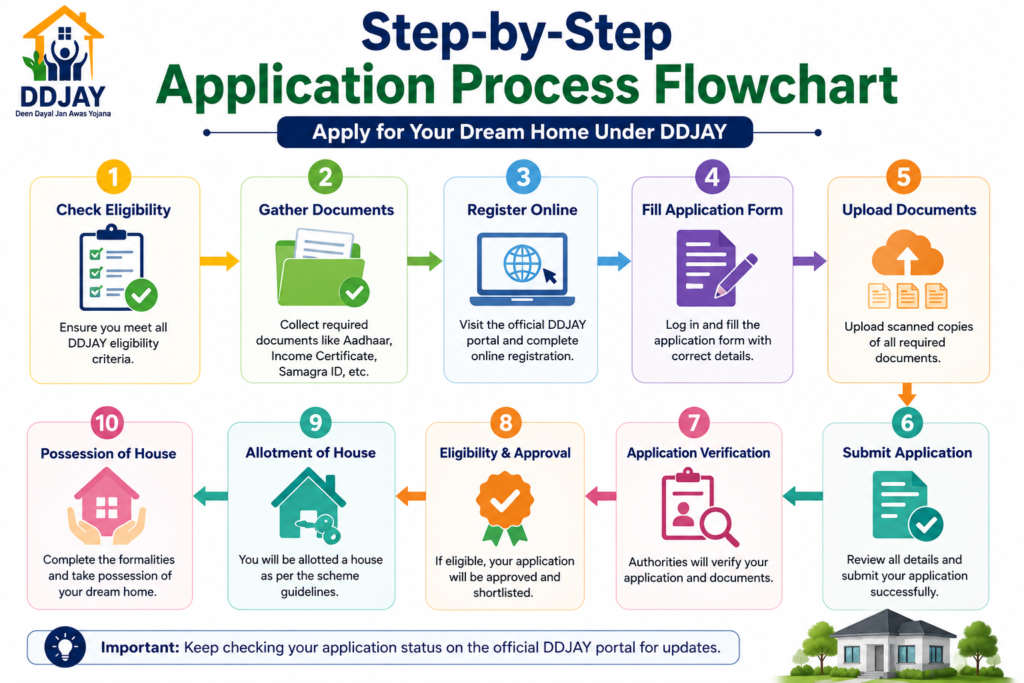
Unlike many government welfare schemes, there is no single government portal where every deen dayal awas yojna applicant submits an application. The Haryana Government provides the policy framework, while licensed private developers launch projects under the scheme. Buyers usually apply directly with the developer for a specific approved project. Always verify the project’s DTCP licence and, where applicable, its HRERA registration before paying any amount.
The application process generally follows these steps.
Step 1: Choose a Licensed Project
Research projects in your preferred location.
Compare:
- Plot prices
- Location
- Connectivity
- Infrastructure
- Developer reputation
- Payment plans
- Possession timeline
Avoid making a decision based only on advertisements.
Step 2: Verify Project Approvals
Before booking a plot, confirm that the project has the required approvals.
Check:
- DTCP Haryana licence
- HRERA registration (where applicable)
- Approved layout plan
- Ownership documents
- Development permissions
Many developers display these documents on their websites, but you should also cross-check with official authorities where possible.
Step 3: Visit the Project Site
Never invest without a physical site visit.
Inspect:
- Road access
- Drainage
- Boundary development
- Nearby schools
- Hospitals
- Markets
- Public transport
- Existing construction progress
A site visit often reveals details that brochures cannot.
Step 4: Submit the Application Form
The developer typically asks you to complete a booking or registration form.
You may need to provide:
- Full name
- Date of birth
- Aadhaar details
- PAN
- Address
- Mobile number
- Email address
- Nominee details
Double-check all information before submission.
Step 5: Upload or Submit Documents
Attach the required KYC and financial documents.
Common documents include:
- Aadhaar Card
- PAN Card
- Passport-size photographs
- Address proof
- Income proof (if applying for a loan)
- Bank statements
- Cancelled cheque (if required)
Some developers also allow online document uploads.
Step 6: Pay the Booking Amount
After document verification, the developer will ask for a booking or registration amount.
Always ensure that you receive:
- Official receipt
- Booking acknowledgement
- Payment confirmation
- Terms and conditions
Never make payments to personal bank accounts.
Step 7: Plot Allotment
Depending on the project, plots may be allotted through:
- First-come, first-served basis
- Draw of lots
- Developer’s allotment process
The method varies from project to project. Read the allotment terms carefully before booking.
Step 8: Execute the Buyer’s Agreement
Once your plot is allotted, the developer generally prepares a Buyer’s Agreement.
Read every clause carefully.
Pay attention to:
- Possession timeline
- Construction obligations
- Cancellation policy
- Transfer conditions
- Maintenance charges
- Delay compensation clauses (if applicable)
If needed, seek legal advice before signing.
Online Application Process
Many developers now offer online registration.
The process usually includes:
- Visit the developer’s website.
- Select the desired project.
- Click Apply or Register.
- Fill in your personal details.
- Upload documents.
- Pay the registration amount through approved payment methods.
- Download your acknowledgement receipt.
Some projects also provide online tracking for application status.
Payment Plans
One reason deen dayal awas yojna projects attract buyers is the availability of flexible payment options, although these differ by developer.
Common payment plans include:
Down Payment Plan
A larger amount is paid upfront, with the balance due at registration or possession.
Suitable for buyers with sufficient savings.
Construction-Linked Plan
Payments are made as development milestones are completed.
For example:
- Booking
- Licence approval
- Infrastructure completion
- Registry
- Possession
Possession-Linked Plan
A smaller initial payment is made, with a significant portion payable closer to possession.
Installment Plan
The cost of the plot is divided into scheduled installments over a defined period.
Always ask for a written payment schedule before booking.
Home Loan Availability
Many leading banks and housing finance companies finance approved DDJAY projects after completing their legal and technical evaluation.
Loan approval depends on factors such as:
- Buyer’s income
- Credit score
- Employment
- Property valuation
- Project approvals
Some projects advertise financing of up to around 80% of the property’s value, subject to lender eligibility and policies. Buyers should confirm loan terms directly with the bank or housing finance company.
Can First-Time Buyers Get Benefits?
If you are purchasing your first home, you may also be eligible for housing-related benefits under applicable central or state housing schemes, provided you satisfy their eligibility conditions. These benefits are separate from DDJAY itself and should be verified based on the current government rules at the time of application.
How to Verify a Deen Dayal Awas Yojna Project
Before investing, complete this checklist:
✅ Verify the DTCP licence.
✅ Check the HRERA registration (where applicable).
✅ Review the approved layout plan.
✅ Read the builder-buyer agreement.
✅ Confirm land ownership.
✅ Verify project status.
✅ Review payment milestones.
✅ Visit the project site.
Completing these checks can significantly reduce investment risk.
How Long Does the Process Take?
The timeline varies depending on the project.
A typical sequence is:
| Stage | Estimated Time |
|---|---|
| Registration | Same day |
| Document Verification | 2–7 days |
| Plot Allotment | As per project schedule |
| Agreement Execution | After allotment |
| Registry | As per payment and approvals |
| Possession | According to the developer’s timeline |
These timelines are indicative and differ across projects.
Common Mistakes Buyers Should Avoid
Many property buyers make avoidable mistakes.
Booking Without Verification
Never assume a project is approved simply because it is advertised.
Ignoring the Fine Print
Read every clause related to payments, cancellations, and possession.
Choosing Only on Price
The cheapest plot is not always the best investment. Evaluate connectivity, infrastructure, and future development.
Not Checking Loan Eligibility
Obtain a loan pre-approval if you plan to finance the purchase.
Skipping the Site Visit
Photographs and brochures cannot replace an in-person inspection.
Expert Buying Tips
- Compare multiple deen dayal awas yojna projects before making a decision.
- Buy only in licensed developments.
- Prefer projects with strong infrastructure and good connectivity.
- Keep copies of all receipts and agreements.
- Verify any promises made by sales representatives in writing.
- Consider your long-term financial goals before investing.
Is Deen Dayal Awas Yojna a Good Investment?
Many people buy a deen dayal awas yojna plot not only to build a home but also as a long-term investment. Whether it is a good investment depends on factors such as the project’s location, infrastructure, developer reputation, legal approvals, and future demand.
Several DDJAY projects are located in rapidly developing parts of Haryana where new highways, industrial corridors, logistics parks, and metro connectivity are improving accessibility. These developments may support property values over time, but there is no guarantee of appreciation, and buyers should make decisions based on their financial goals and thorough due diligence.
Best Cities for DDJAY Investment
The Haryana Government has permitted deen dayal awas yojna developments in several low- and medium-potential towns. Some locations have attracted greater buyer interest due to infrastructure growth.
1. Sohna
Sohna has become one of the fastest-growing real estate markets near Gurugram.
Reasons include:
- Delhi–Mumbai Expressway connectivity
- Proximity to Gurugram
- Educational institutions
- Industrial growth
- Growing residential demand
2. Sonipat
Sonipat continues to attract both homebuyers and investors because of its connectivity with Delhi.
Growth drivers include:
- Kundli–Manesar–Palwal (KMP) Expressway
- Industrial development
- Educational institutions
- Metro expansion proposals
3. Panipat
Panipat offers comparatively affordable plotted developments and continues to benefit from industrial activity.
4. Karnal
Karnal has seen increasing residential demand due to improved road connectivity and commercial growth.
5. Jhajjar
Jhajjar and nearby areas have attracted attention because of infrastructure projects and proximity to Delhi NCR.
6. Rewari
Rewari continues to grow as an industrial and logistics hub, making it a preferred destination for many plotted developments.
Factors That Influence Property Appreciation
Before investing, evaluate the following:
Infrastructure
Projects located near highways, railway stations, metro corridors, or industrial zones often attract more demand.
Employment
Areas with strong employment opportunities usually experience greater residential demand.
Social Infrastructure
Look for nearby:
- Schools
- Hospitals
- Shopping centres
- Banks
- Public transport
- Parks
Government Development
Upcoming public infrastructure projects may improve accessibility and increase demand over time.
Risks of Investing in deen dayal awas yojna Projects
Every real estate investment involves risk.
Project Delays
Infrastructure development or possession may take longer than expected in some projects.
Market Fluctuations
Property prices can increase or decrease depending on economic conditions.
Never assume guaranteed returns.
Legal Issues
Failure to verify approvals can create legal complications.
Always verify:
- DTCP licence
- HRERA registration (where applicable)
- Land ownership
- Approved layout plan
Developer Performance
Different developers have different execution capabilities.
Research:
- Previous projects
- Delivery history
- Customer reviews
- Financial stability
Latest deen dayal awas yojna Updates (2026)
The DDJAY policy continues to support affordable plotted housing through licensed developments across Haryana. New projects continue to be launched by approved developers, and project-specific registration windows open periodically. Buyers should always rely on the latest information from the developer, DTCP Haryana, and HRERA before applying.
Recent government updates also indicate continued licensing activity under the scheme, with additional licences issued for affordable plotted housing across Haryana.
Deen Dayal Awas Yojna vs Regular Residential Plots
| Feature | DDJAY Plot | Regular Plot |
|---|---|---|
| Government Policy Framework | Yes | Not necessarily |
| Licensed Development | Yes | Depends on the project |
| Planned Infrastructure | Generally included | Varies |
| Roads & Utilities | Planned | May vary |
| Developer Regulation | Subject to applicable approvals | Depends on local regulations |
| Affordable Housing Focus | Yes | Not always |
Deen Dayal Awas Yojna vs High-Rise Apartments
| DDJAY Plots | Apartments |
|---|---|
| Independent home construction | Ready-built homes |
| Greater design flexibility | Standard layouts |
| Land ownership | Apartment ownership |
| Potential expansion | Limited expansion |
| Lower population density | Higher population density |
The better choice depends on your lifestyle, budget, and long-term plans.
Who Should Invest?
DDJAY may be suitable for:
First-Time Buyers
If you want to build your own home rather than buy an apartment.
Long-Term Investors
If your investment horizon is 7–15 years and you are comfortable with market risks.
Families
If you prefer independent living in a low-rise community.
NRIs
Subject to Indian property laws and the specific project’s conditions.
Who Should Avoid Investing?
You may want to reconsider if:
- You need immediate possession.
- You cannot afford long-term holding costs.
- You have not verified the project’s approvals.
- You expect guaranteed short-term profits.
Expert Tips Before Buying
Verify Everything
Do not rely only on marketing brochures.
Compare Multiple Projects
Never book the first project you visit.
Check Connectivity
A good location often matters more than a low price.
Understand the Payment Plan
Know when each installment is due.
Review the Agreement
Read every clause before signing.
Keep Financial Records
Maintain copies of:
- Booking receipts
- Agreements
- Payment proofs
- Emails
- Approval documents
Buyer Checklist
Before paying the booking amount, confirm:
- ✅ DTCP licence verified
- ✅ HRERA registration checked (where applicable)
- ✅ Title documents reviewed
- ✅ Layout plan approved
- ✅ Infrastructure timeline understood
- ✅ Payment schedule received
- ✅ Site visited
- ✅ Home loan eligibility confirmed
- ✅ Legal opinion obtained (if needed)
- ✅ Cancellation policy understood
Following this checklist can reduce the chances of costly mistakes.
Frequently Asked Questions (FAQs)
1. What is Deen Dayal Awas Yojna?
Deen Dayal Jan Awas Yojana (DDJAY) is a Haryana Government policy introduced in 2016 to encourage affordable plotted housing through licensed residential colonies developed by private developers under state planning regulations.
2. Is Deen Dayal Awas Yojna only available in Haryana?
Yes. deen dayal awas yojna is a policy of the Haryana Government and applies to eligible residential developments within Haryana.
3. Is DDJAY a government housing scheme?
It is a government policy for affordable plotted housing. The plots are generally developed and sold by licensed private developers, not directly by the government.
4. Can I apply online?
Many developers provide online registration through their official websites. The application process depends on the individual project.
5. What documents are required?
Commonly required documents include:
- Aadhaar Card
- PAN Card
- Address proof
- Passport-size photographs
- Income proof (if applying for a home loan)
- Bank statements
The exact list may vary by developer.
6. Can I get a home loan?
Yes. Many approved deen dayal awas yojna projects are financed by banks and housing finance companies, subject to the lender’s eligibility criteria and legal verification of the project.
7. Is the plot freehold?
Most DDJAY projects offer freehold residential plots, but buyers should verify the ownership structure in the project’s legal documents before purchasing.
8. Can NRIs buy DDJAY plots?
In many cases, NRIs can purchase residential property in India under applicable laws. Buyers should confirm eligibility with the developer and consult legal or financial advisers if necessary.
9. What plot sizes are available?
Plot sizes vary by project. Common offerings include approximately:
- 60 sq. m (about 72 sq. yd.)
- 90 sq. yd.
- 120 sq. yd.
- 150 sq. yd.
- Up to 150 sq. m (about 179 sq. yd.)
10. Can I build my own house?
Yes. Buyers generally have the flexibility to construct a house according to the applicable building rules and project guidelines.
11. Are all DDJAY projects approved by DTCP?
Licensed deen dayal awas yojna projects require approvals under the policy framework. Buyers should independently verify the DTCP licence and other approvals before booking.
12. Is HRERA registration required?
Many projects are registered with the Haryana Real Estate Regulatory Authority (HRERA), where applicable. Always verify the registration status before investing.
13. How do I check if a project is genuine?
Verify:
- DTCP licence
- HRERA registration (where applicable)
- Land ownership
- Approved layout plan
- Developer credentials
- Customer reviews
14. Is there any income limit to purchase a plot?
Unlike some government subsidy schemes, DDJAY itself does not prescribe a universal income limit for all buyers. Eligibility may depend on the specific project’s terms and financing requirements.
15. Is GST applicable?
Taxes, including GST where applicable, depend on the stage of the project and prevailing tax laws. Consult the developer or a tax professional for project-specific guidance.
16. Can I sell my plot later?
Yes, subject to the applicable laws, project conditions, and any contractual restrictions.
17. Which cities have the most DDJAY projects?
Popular locations include:
- Sohna
- Sonipat
- Panipat
- Karnal
- Jhajjar
- Rewari
- Gurugram (selected surrounding areas)
18. Is DDJAY suitable for investment?
It can be suitable for long-term investors, but there is no guarantee of appreciation. Evaluate location, infrastructure, legal approvals, and market conditions before investing.
19. Can I purchase jointly with my spouse?
Many developers allow joint ownership. Confirm the specific requirements during the booking process.
20. Where can I verify project approvals?
You can verify project approvals through the relevant Haryana authorities, including the Department of Town and Country Planning (DTCP) and HRERA, where applicable.
Common Myths and Facts
| Myth | Fact |
|---|---|
| DDJAY plots are free from the government. | No. Buyers purchase plots from licensed developers under the DDJAY policy. |
| Every project offers identical facilities. | Amenities vary by developer and project. |
| Property prices always increase. | Real estate values depend on market conditions and are not guaranteed. |
| Every project qualifies for a bank loan. | Loan approval depends on both the project and the buyer’s eligibility. |
| You don’t need to verify approvals. | Always verify licences and approvals before making any payment. |
Key Takeaways
Before investing in a DDJAY project, remember these important points:
- Buy only in licensed projects.
- Verify DTCP and HRERA approvals where applicable.
- Visit the project site.
- Read the buyer agreement carefully.
- Compare multiple projects.
- Understand the payment schedule.
- Keep copies of all documents and receipts.
- Plan your finances before booking.
Final Thoughts
The Deen Dayal Jan Awas Yojana (DDJAY) has become one of Haryana’s most recognized affordable plotted housing policies. It offers buyers the opportunity to purchase residential plots in planned, licensed colonies while providing the flexibility to build homes according to approved regulations.
For first-time homebuyers, deen dayal awas yojna can be an attractive option because it combines planned infrastructure with the freedom of independent home construction. For investors, projects located in areas with strong infrastructure development and employment growth may offer long-term potential, although property investments always involve risk.
The most important step before investing is to verify all legal approvals, understand the project’s terms, and ensure that the property aligns with your financial goals. Careful research and due diligence can help you make a more informed and confident decision.
Official References
For the most reliable and up-to-date information, refer to:
- Department of Town and Country Planning (DTCP), Haryana
- Haryana Real Estate Regulatory Authority (HRERA)
- The official project documentation provided by the licensed developer
Natalie Kingsley is the lead author and primary contributor at Fundznests.com. She is passionate about financial education and dedicated to helping readers build confidence in managing their money, growing their wealth, and achieving long-term financial goals.
With a strong interest in personal finance, investing, retirement planning, and wealth-building strategies, Natalie creates informative and practical content designed for both beginners and experienced investors. Her writing focuses on breaking down complex financial concepts into clear, actionable insights that readers can apply to their everyday financial lives.