

Real estate has remained one of the most reliable ways to build wealth for generations. While stock markets can fluctuate daily and cryptocurrencies often experience significant volatility, quality real estate has historically offered a combination of long-term appreciation, rental income, tax advantages, and portfolio diversification. That is why investors ranging from first-time buyers to experienced professionals continue to include property in their investment strategies.
However, buying a property alone does not guarantee success. Profitable investing requires research, financial planning, market knowledge, patience, and disciplined decision-making. Many beginners purchase properties based on emotions or social media hype instead of analyzing cash flow, expenses, and long-term growth potential. These mistakes can reduce returns or even lead to financial losses.
This guide shares practical and actionable real estate investing tips that can help both beginners and experienced investors make smarter decisions in today’s market. Whether your goal is earning passive rental income, building long-term wealth, or diversifying your investment portfolio, understanding these principles can help you reduce risk and improve your chances of success.
Please note that this article is for educational purposes only and should not be considered financial, tax, or legal advice. Consider consulting qualified professionals before making major investment decisions.
Why Real Estate Investing Still Makes Sense in 2026
Real estate continues to be an attractive asset because it combines income generation with the possibility of capital appreciation. Unlike many other investments, a property can produce monthly rental income while potentially increasing in value over time.
Several factors continue to support real estate investing in 2026.
- Growing urban populations continue to create housing demand in many regions.
- Rental markets remain active as affordability challenges encourage more people to rent.
- Property can provide diversification alongside stocks, bonds, and mutual funds.
- Investors may benefit from leverage through mortgage financing.
- Rental income can help offset inflation over long investment periods.
Of course, not every market performs the same way. Successful investors study local conditions instead of relying solely on national headlines.
Different Ways to Invest in Real Estate
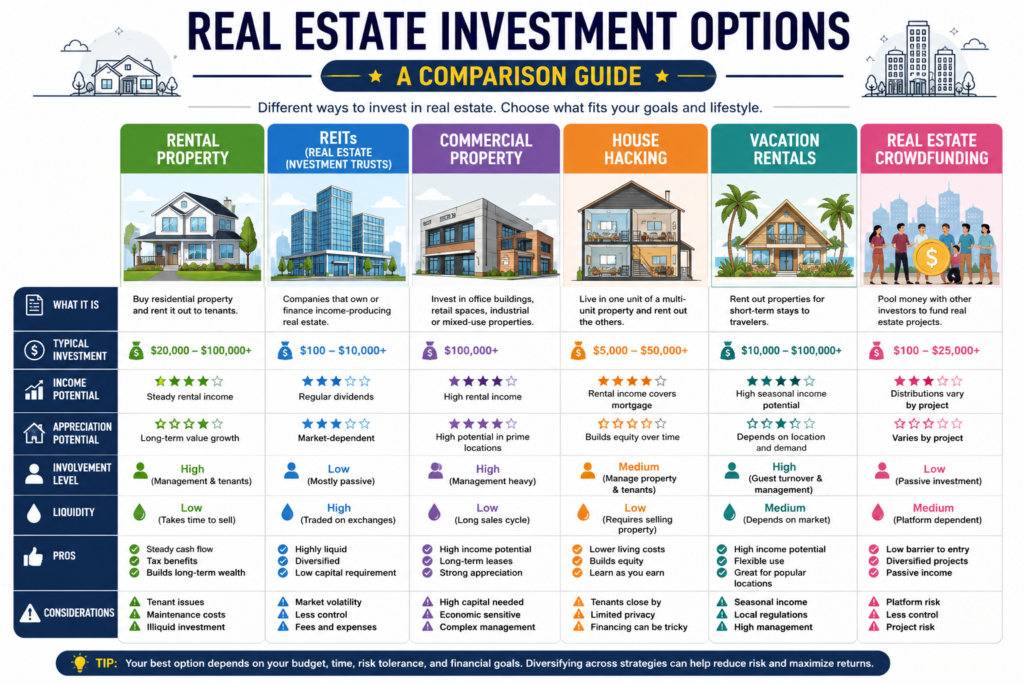
One of the biggest misconceptions is that investing in real estate always requires purchasing an expensive residential property. In reality, investors have several options depending on their budget, experience, and financial goals.
Rental Properties
Buying residential or commercial property and renting it to tenants remains one of the most popular strategies. Investors earn monthly rental income while benefiting from potential appreciation.
Best suited for:
- Long-term wealth creation
- Passive income seekers
- Investors comfortable managing property
Real Estate Investment Trusts (REITs)
Important real estate investing tips – REITs allow investors to buy shares in companies that own income-producing real estate. They provide exposure to property markets without directly owning physical buildings.
Suitable for investors who:
- Have limited capital
- Prefer liquidity
- Do not want property management responsibilities
House Hacking
House hacking involves living in one part of a property while renting the remaining units or rooms. This strategy helps reduce housing expenses and build equity simultaneously.
Commercial Real Estate
Commercial buildings include offices, retail stores, warehouses, and industrial properties. These investments often involve higher capital but may generate larger rental income.
Vacation Rentals
Short-term rental platforms have created opportunities for investors in tourist destinations. While returns can be attractive, income may fluctuate with travel demand and local regulations.
Real Estate Crowdfunding
Modern investment platforms allow multiple investors to contribute toward large real estate projects. This lowers the entry barrier for beginners.
Before You Invest: Ask Yourself These Questions
Pro real estate investing tips -Every successful investment starts with honest self-assessment.
Ask yourself:
- Why am I investing?
- What is my investment horizon?
- Can I handle unexpected expenses?
- How much risk am I comfortable taking?
- Do I want active involvement or passive income?
- What happens if rental income stops for several months?
Your answers will influence the type of property and investment strategy that best suits your needs.
25 Proven Real Estate Investing Tips
1. Define Clear Investment Goals
Some investors prioritize monthly cash flow, while others focus on long-term appreciation. Define your objective before searching for properties.
2. Build an Emergency Fund
Unexpected repairs, vacancies, insurance claims, or economic downturns can affect rental income. Keeping emergency savings helps avoid financial stress.
Many experienced investors maintain reserves covering several months of property expenses.
3. Never Buy Based on Emotion
Beautiful interiors or attractive architecture should never replace financial analysis.
Successful investors evaluate numbers first.
Ask questions such as:
- Will this property generate positive cash flow?
- Is the location growing?
- What are future maintenance costs?
- Does the expected return justify the investment?
4. Research the Local Market Thoroughly
Location remains one of the strongest factors affecting property value.
Study:
- Population growth
- Employment opportunities
- Infrastructure development
- School quality
- Crime rates
- Transportation access
- Future government projects
Strong local economies generally support stronger housing demand.
5. Understand Cash Flow
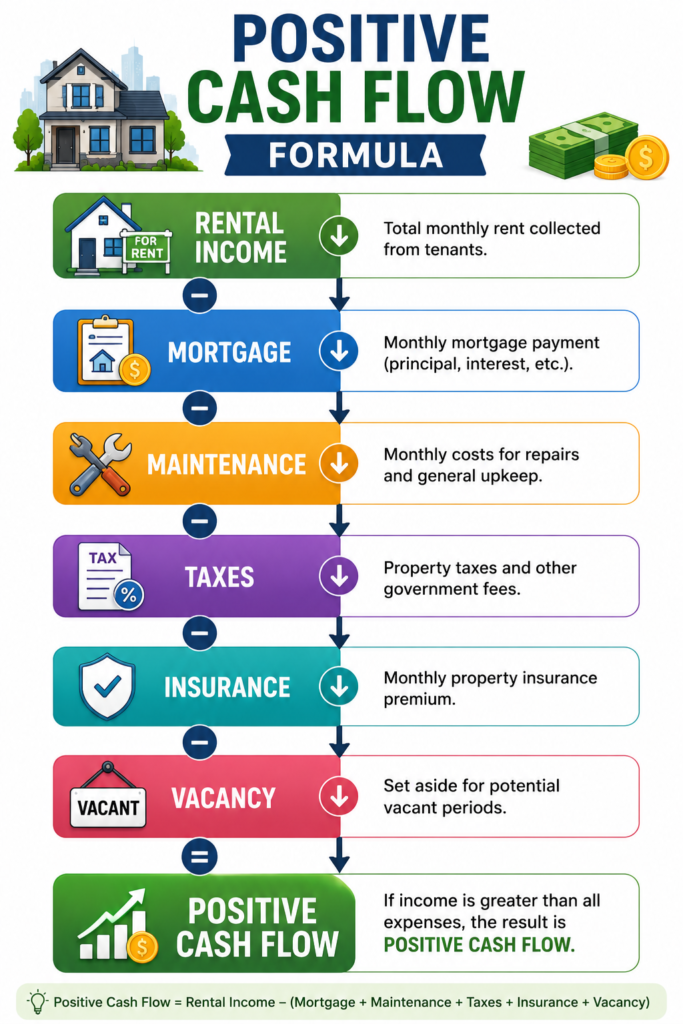
Positive cash flow means rental income exceeds monthly expenses.
Expenses typically include:
- Mortgage payments
- Insurance
- Property taxes
- Maintenance
- Vacancy allowance
- Property management fees
- Utilities (if applicable)
Positive cash flow provides greater financial stability during market fluctuations.
6. Learn the 1% Rule
Important real estate investing tips – Some investors use the 1% rule as an initial screening method.
The rule suggests monthly rent should ideally equal approximately 1% of the purchase price.
Although this rule is not suitable for every market, it offers a useful starting point for comparing opportunities.
7. Calculate Cap Rate
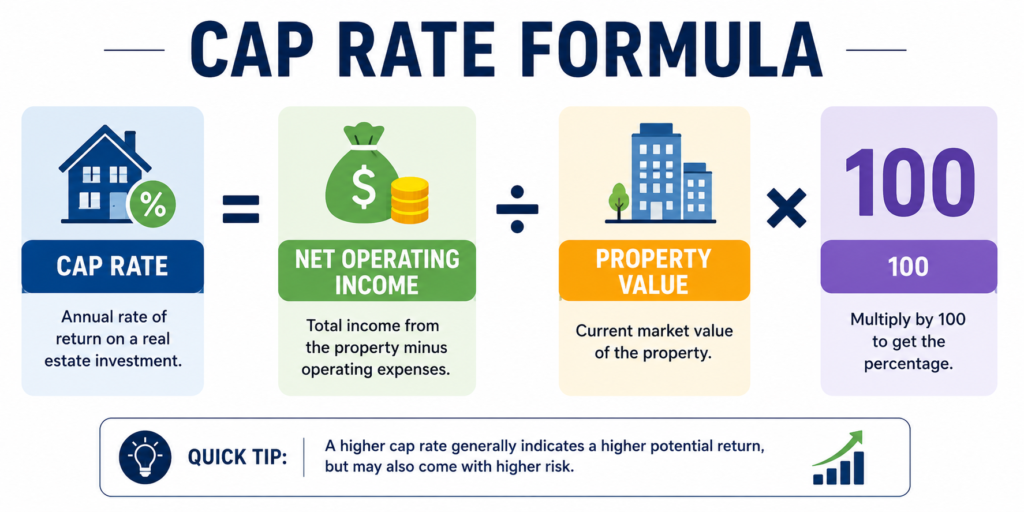
Capitalization Rate (Cap Rate) measures potential investment return.
Formula:
Cap Rate = Net Operating Income ÷ Property Value × 100
Higher cap rates often indicate higher potential returns but may also involve greater risk.
8. Evaluate Cash-on-Cash Return
This metric measures the annual return on the actual cash invested rather than the property’s full value.
It becomes especially useful when financing investments with mortgages.
9. Don’t Ignore Hidden Costs
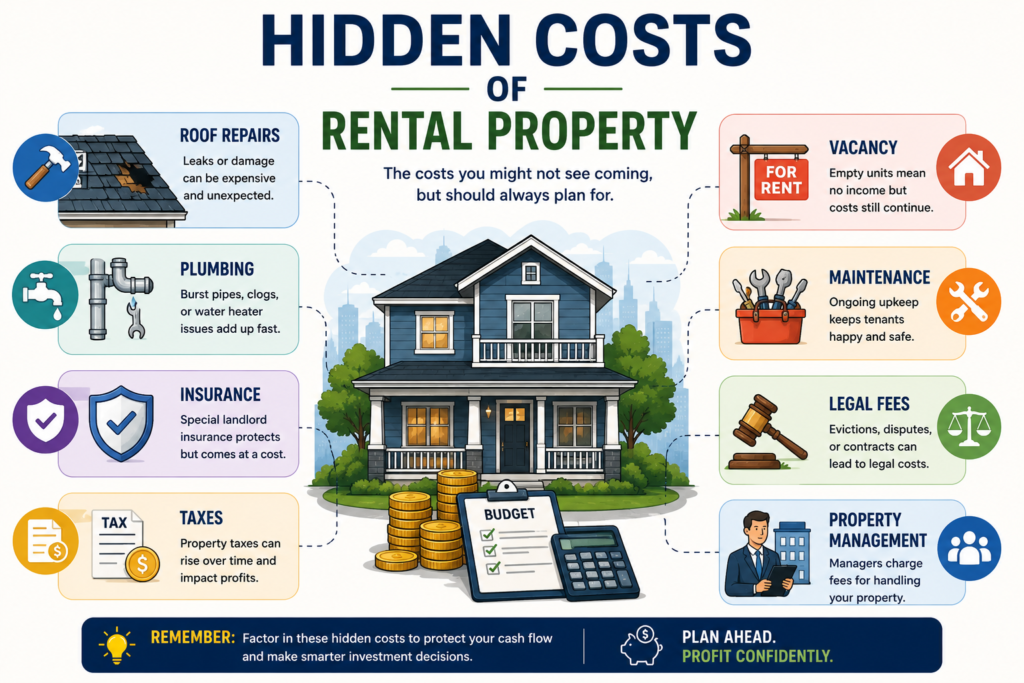
Many beginners underestimate ownership expenses.
Potential hidden costs include:
- Roof replacement
- Plumbing repairs
- Electrical upgrades
- Appliance replacement
- HOA fees
- Legal expenses
- Tenant turnover costs
- Landscaping
- Vacancy periods
Budgeting conservatively reduces unpleasant surprises.
10. Start Small
Buying one manageable property often teaches more than purchasing multiple properties too quickly.
Learning property management gradually reduces expensive mistakes.
11. Avoid Overleveraging
Using debt wisely can increase returns.
Using excessive debt increases financial risk.
Ensure mortgage payments remain manageable even if rental income temporarily declines.
12. Screen Tenants Carefully
Reliable tenants often determine whether an investment succeeds.
Consider checking:
- Employment history
- Income stability
- Rental history
- References
- Credit reports (where legally permitted)
Choosing quality tenants reduces vacancy and maintenance issues.
13. Diversify Your Portfolio
Avoid concentrating all investments in one neighborhood or one property type.
Diversification may include:
- Residential properties
- Commercial buildings
- REITs
- Different cities
- Different tenant segments
Diversification helps reduce overall investment risk.
14. Focus on Long-Term Growth
Real estate generally rewards patience.
Short-term price fluctuations matter less when properties generate steady rental income over many years.
15. Continue Learning
Successful investors regularly study:
- Housing market reports
- Interest rate trends
- Economic indicators
- Tax law changes
- Local regulations
Continuous education improves future investment decisions.
Common Beginner Mistakes That Can Cost Thousands
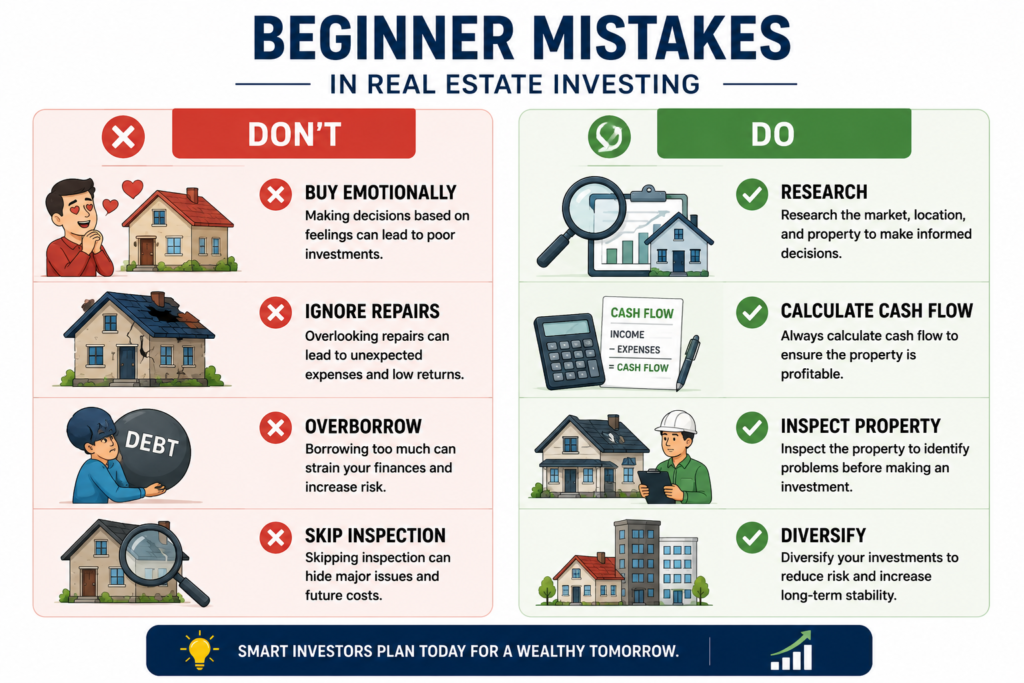
Many investment losses occur because investors repeat avoidable mistakes.
Some of the most common include:
- Purchasing without research
- Ignoring repair costs
- Overestimating rental income
- Underestimating vacancies
- Taking excessive debt
- Buying in declining neighborhoods
- Failing to inspect the property
- Making emotional decisions
- Ignoring legal requirements
- Not keeping financial records
Avoiding these mistakes can significantly improve long-term investment performance.
How to Analyze an Investment Property
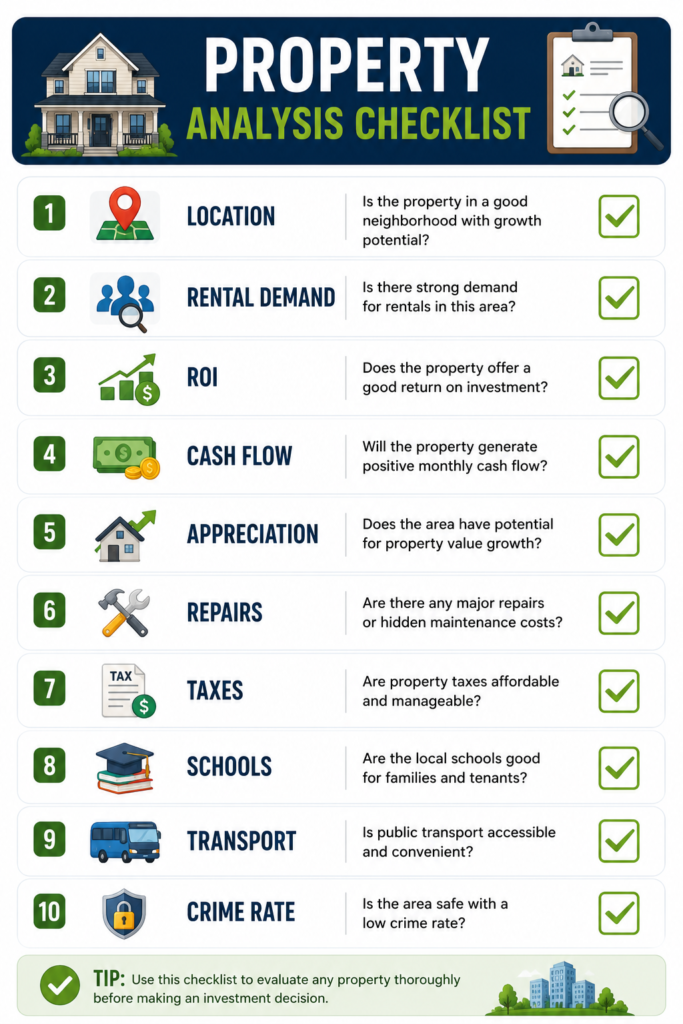
Professional investors rarely make decisions based on photographs or advertisements alone.
A comprehensive property analysis typically includes:
Purchase Price
Compare similar recently sold properties in the area rather than relying solely on the asking price.
Expected Rental Income
Research actual rental rates for comparable properties nearby.
Operating Expenses
Estimate:
- Taxes
- Insurance
- Repairs
- Vacancy allowance
- Maintenance
- Property management
- Utilities
- Legal compliance
Neighborhood Growth
Look for:
- New infrastructure
- Corporate investments
- Schools
- Hospitals
- Public transport
- Employment growth
Exit Strategy
Always know how you would exit the investment if market conditions change.
This might include selling, refinancing, converting to another rental strategy, or holding for long-term appreciation.
Try Our Free Rental Property ROI Calculator
Before purchasing any investment property, it’s important to estimate your expected return. Use the calculator below to quickly estimate your annual ROI based on the property’s purchase price, rental income, operating expenses, and financing costs. While this tool provides an estimate, it can help you compare multiple investment opportunities more confidently.
Rental Property ROI Calculator
Estimate rental cash flow, net operating income, cap rate and cash-on-cash return before purchasing an investment property.
Enter Property Details
Property Investment
Rental Income
Monthly Expenses
Estimated Results
Effective rental income − operating expenses, excluding mortgage payments.
Annual Cash Flow:
Net operating income − annual mortgage payments.
Cap Rate:
Net operating income ÷ purchase price × 100.
Cash-on-Cash Return:
Annual cash flow ÷ total cash invested × 100.
16. Buy Below Market Value Whenever Possible
Experienced investors understand that profits are often made when purchasing a property, not when selling it. Buying below market value creates an immediate equity cushion and provides greater flexibility if market conditions change.
Ways to identify undervalued properties include:
- Motivated sellers
- Foreclosures (where appropriate and after due diligence)
- Properties requiring cosmetic renovations
- Off-market opportunities
- Estate sales
- Long-listed properties with negotiable prices
Always compare recent sales of similar properties before deciding whether a property is truly undervalued.
17. Pay Attention to Infrastructure Development
Infrastructure projects can significantly influence property prices over time.
Keep an eye on developments such as:
- New metro lines
- Highway expansions
- Airports
- Business parks
- IT hubs
- Shopping centers
- Universities
- Hospitals
Areas receiving major public and private investment often experience increased housing demand in the coming years.
18. Understand Local Laws and Regulations
Every city or country has different rules regarding property ownership, taxation, rental agreements, tenant rights, zoning, and building permits.
Ignoring these regulations can lead to unexpected legal and financial complications.
Before investing, verify:
- Property ownership records
- Local zoning rules
- Rental regulations
- Property tax obligations
- Registration requirements
- Building approvals
- Society or HOA restrictions
Consulting a qualified legal professional before closing a property transaction is often worthwhile.
19. Renovate Strategically
Not every renovation increases property value.
Focus on improvements that typically offer better returns, such as:
- Modern kitchens
- Bathroom upgrades
- Fresh interior paint
- Energy-efficient lighting
- Flooring improvements
- Exterior curb appeal
- Security enhancements
Luxury upgrades may not always produce proportional increases in rental income or resale value.
20. Keep Accurate Financial Records
Successful investors treat real estate like a business.
Maintain records for:
- Rental income
- Maintenance expenses
- Mortgage payments
- Insurance
- Property taxes
- Improvement costs
- Utility bills
- Professional service fees
Organized records simplify tax filing and help evaluate investment performance.
21. Review Your Portfolio Regularly
Markets change over time.
Review each property’s performance annually by analyzing:
- Rental growth
- Occupancy rate
- Maintenance costs
- Appreciation
- Cash flow
- Local market trends
If a property consistently underperforms, consider whether holding, improving, refinancing, or selling is the best option.
22. Protect Your Investment with Insurance
Insurance is often overlooked until something goes wrong.
Depending on the property, investors may consider:
- Building insurance
- Landlord insurance
- Liability coverage
- Flood insurance (where applicable)
- Natural disaster coverage
Appropriate insurance helps protect both the property and your financial position.
23. Build Relationships with Local Professionals
Successful investors rarely work alone.
A reliable network may include:
- Real estate agents
- Property managers
- Contractors
- Electricians
- Plumbers
- Accountants
- Lawyers
- Mortgage advisors
- Building inspectors
Having trusted professionals can save time, reduce costs, and help resolve issues quickly.
24. Stay Patient During Market Cycles
Real estate markets naturally experience periods of growth, stability, and decline.
Attempting to perfectly time the market is difficult.
Instead, focus on:
- Strong fundamentals
- Sustainable cash flow
- Quality locations
- Reasonable purchase prices
- Long-term ownership
Patience often rewards disciplined investors.
25. Never Stop Improving Your Knowledge
The best investors continue learning throughout their careers.
Read industry reports, attend seminars, follow respected economists, and study successful investors’ strategies.
Markets evolve, financing options change, and regulations are updated regularly. Continuous education helps investors adapt confidently.
Financing Options for Real Estate Investors
Choosing the right financing method can influence both profitability and risk.
Traditional Home Loans
These remain the most common option for residential properties. Interest rates, loan terms, and eligibility vary by lender.
Suitable for:
- First-time investors
- Long-term rental properties
Investment Property Loans
Some lenders offer specialized loans designed specifically for rental or investment properties.
These often require:
- Larger down payments
- Higher credit scores
- Stronger income documentation
Commercial Property Loans
Commercial properties generally require specialized financing and different underwriting standards.
Private Lenders
Private financing may provide flexibility but often carries higher borrowing costs.
Real Estate Partnerships
Investors sometimes combine financial resources with partners to purchase larger properties while sharing both risks and rewards.
Rental Property vs REITs
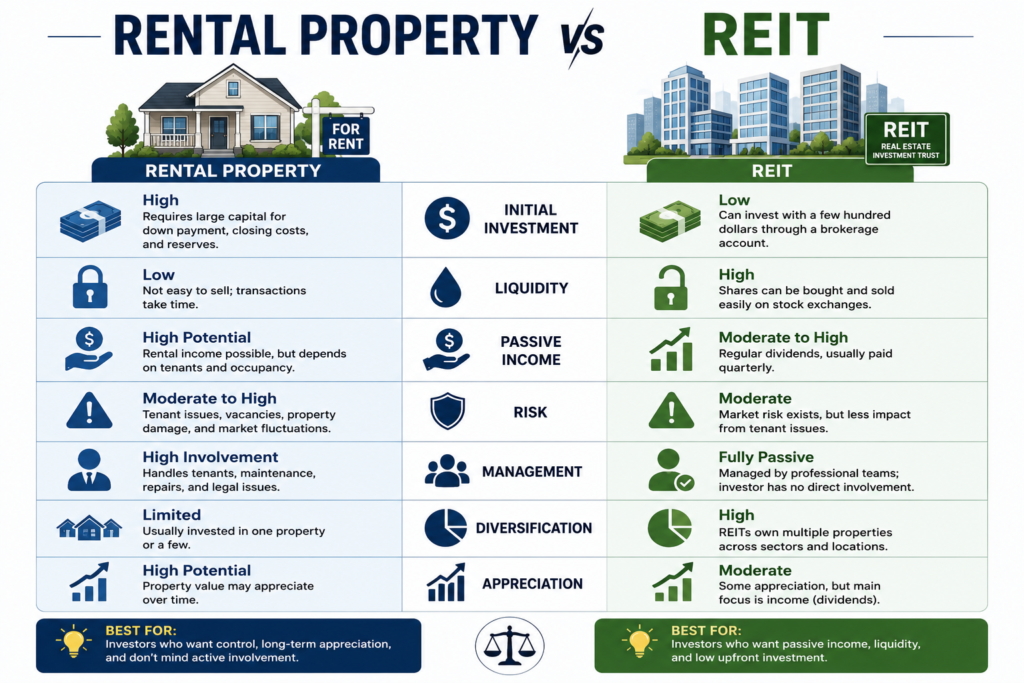
| Factor | Rental Property | REIT |
|---|---|---|
| Ownership | Direct | Indirect |
| Initial Investment | Higher | Lower |
| Liquidity | Low | High |
| Monthly Income | Rental Income | Dividend Income |
| Property Management | Required | None |
| Diversification | Limited | Usually Higher |
| Control | Full | Limited |
| Market Accessibility | Moderate | Easy |
Neither option is universally better. The right choice depends on your financial goals, available capital, time commitment, and risk tolerance.
Some investors combine both approaches for greater diversification.
Understanding the Key Numbers Every Investor Should Know
Successful investing depends on analyzing numbers rather than relying on opinions.
Cash Flow
Monthly rental income after deducting operating expenses.
Positive cash flow generally strengthens investment stability.
Net Operating Income (NOI)
Income generated by the property after operating expenses but before financing costs.
Cap Rate
Measures investment return relative to property value.
Useful when comparing multiple properties.
Cash-on-Cash Return
Measures annual return based on the investor’s actual cash investment.
Especially useful when financing properties with loans.
Appreciation
Increase in property value over time.
Although appreciation can significantly increase wealth, it should not be the only reason to invest.
Occupancy Rate
Represents the percentage of time a property remains rented.
Higher occupancy generally supports consistent cash flow.
Risk Management Strategies
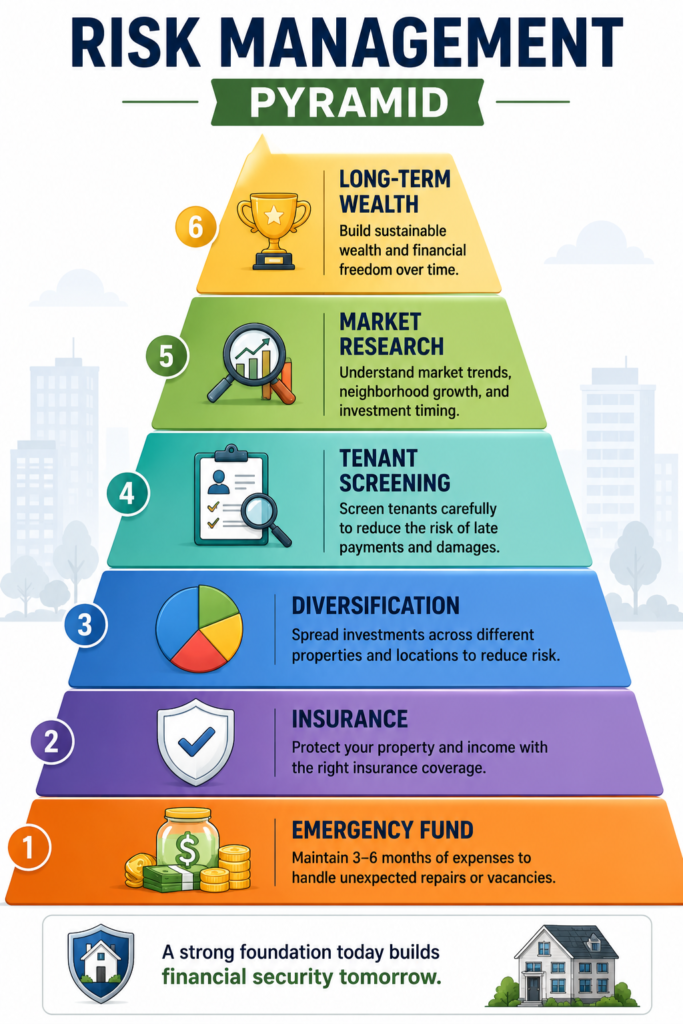
Every investment carries risk.
Managing risk effectively often determines long-term success.
Diversify investments rather than concentrating all capital in one property.
Maintain emergency reserves for repairs and vacancies.
Avoid excessive borrowing.
Conduct thorough inspections before purchasing.
Review insurance coverage regularly.
Understand local market conditions before investing.
Prepare for changing interest rates.
Avoid speculative buying based solely on expected appreciation.
Have a clear exit strategy before making any purchase.
Successful investors focus on controlling risks instead of chasing unrealistic returns.
Tax Considerations
Tax rules differ by country and individual circumstances.
Investors should understand how taxes affect overall returns.
Common tax-related considerations include:
- Rental income taxation
- Capital gains tax
- Property taxes
- Interest deductions (where applicable)
- Depreciation rules
- Maintenance expense deductions
Because tax laws frequently change, consulting a qualified tax professional is recommended before making major investment decisions.
A Practical Example
Imagine two investors purchasing similar apartments.
Investor A buys based on attractive interiors without analyzing rental demand.
Investor B researches the neighborhood, compares rental prices, calculates cash flow, estimates maintenance expenses, and negotiates a better purchase price.
Five years later:
Investor A struggles with vacancies and unexpected repair costs.
Investor B benefits from consistent rental income, higher occupancy, and increasing property value.
The difference isn’t luck.
It’s preparation.
Real Estate Investment Checklist
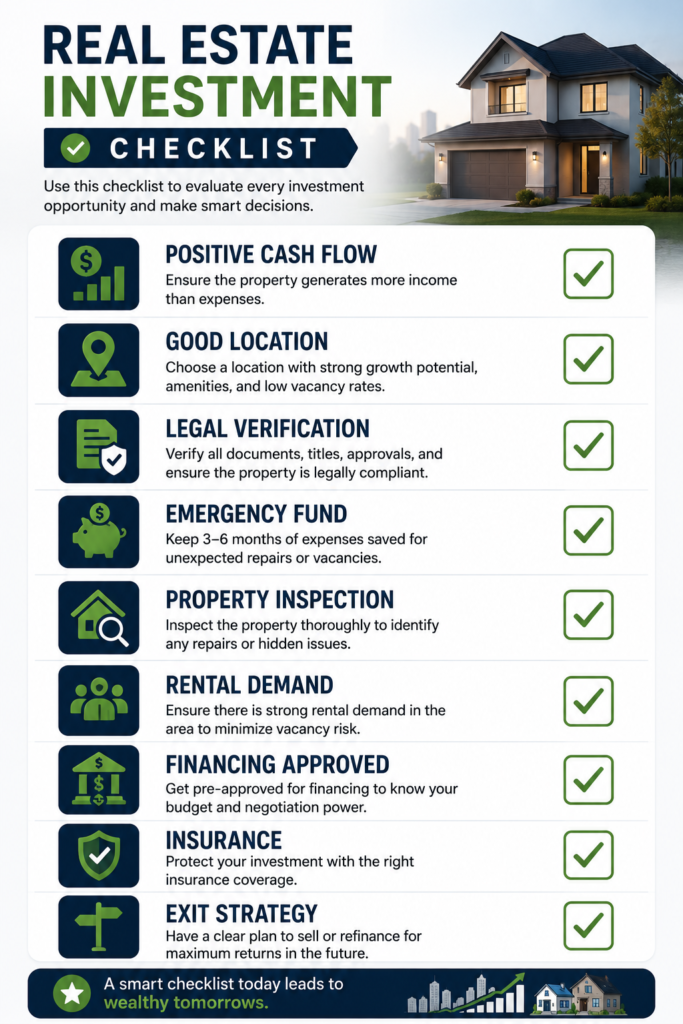
Before purchasing any property, ask yourself:
✅ Does the property generate positive cash flow?
✅ Have I inspected the building?
✅ Is the location growing?
✅ Can I comfortably afford the mortgage?
✅ Have I budgeted for maintenance?
✅ Have I researched rental demand?
✅ Is the neighborhood safe?
✅ Are schools, hospitals, and transport nearby?
✅ Have I verified legal ownership?
✅ Have I calculated expected ROI?
✅ Do I have emergency savings?
✅ What is my exit strategy?
If several answers are “No,” reconsider the investment before proceeding.
What Successful Real Estate Investors Do Differently
Many people assume successful investors simply have more money to invest. While access to capital can help, long-term success is usually driven by discipline, research, and consistent decision-making rather than luck.
Here are habits commonly seen among experienced real estate investors.
They Think Like Business Owners
A profitable property is not just a house or an apartment. It is a business asset that should generate measurable returns.
Before buying, they calculate:
- Expected rental income
- Operating expenses
- Vacancy costs
- Maintenance budget
- Financing costs
- Long-term appreciation potential
Every purchase must support their financial goals.
They Focus on Data Instead of Headlines
News articles often highlight booming or declining property markets, but experienced investors go deeper.
They analyze:
- Local employment trends
- Population growth
- Rental demand
- Infrastructure projects
- Historical price movement
- Housing supply
- Vacancy rates
Local market fundamentals usually matter more than national headlines.
They Buy for the Long Term
Many first-time investors expect quick profits.
However, real estate has traditionally rewarded patience. Holding quality properties through multiple market cycles may allow investors to benefit from appreciation, rental income, and loan principal reduction over time.
They Keep Cash Reserves
Unexpected repairs are inevitable.
Examples include:
- Roof damage
- Water leaks
- HVAC replacement
- Plumbing issues
- Vacancies between tenants
Having emergency funds helps investors handle these situations without selling assets under pressure.
They Continue Learning
Successful investors stay informed about:
- Interest rate movements
- Government housing policies
- Tax law changes
- Construction costs
- Rental trends
- Financing options
- Technology affecting real estate
Continuous learning helps investors adapt to changing market conditions.
How to Build a Real Estate Portfolio Step by Step
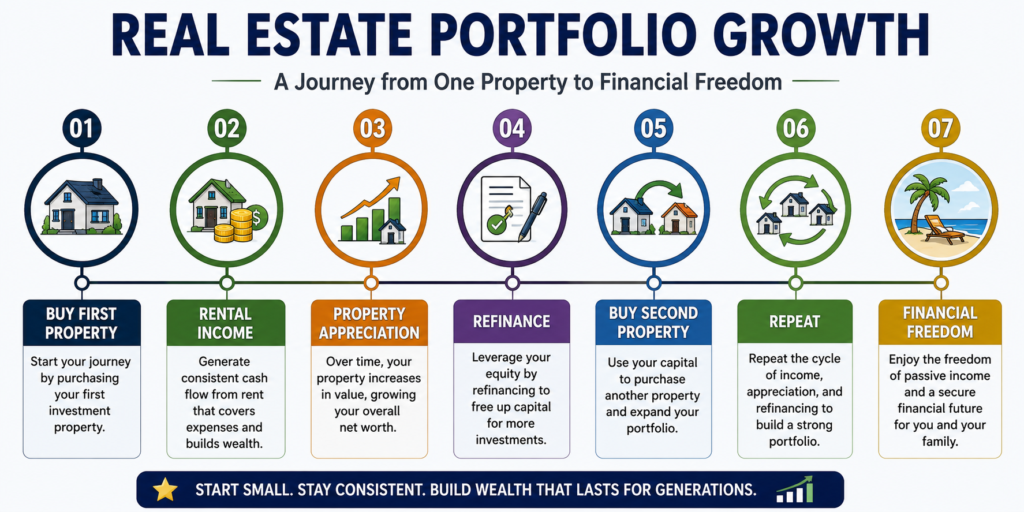
Building wealth through real estate usually happens gradually rather than overnight.
Step 1: Improve Your Financial Foundation
Before buying your first investment property:
- Pay down high-interest debt where possible.
- Build an emergency fund.
- Improve your credit profile (if relevant in your market).
- Save for a down payment and closing costs.
A strong financial foundation gives you more flexibility and better financing options.
Step 2: Choose the Right Investment Strategy
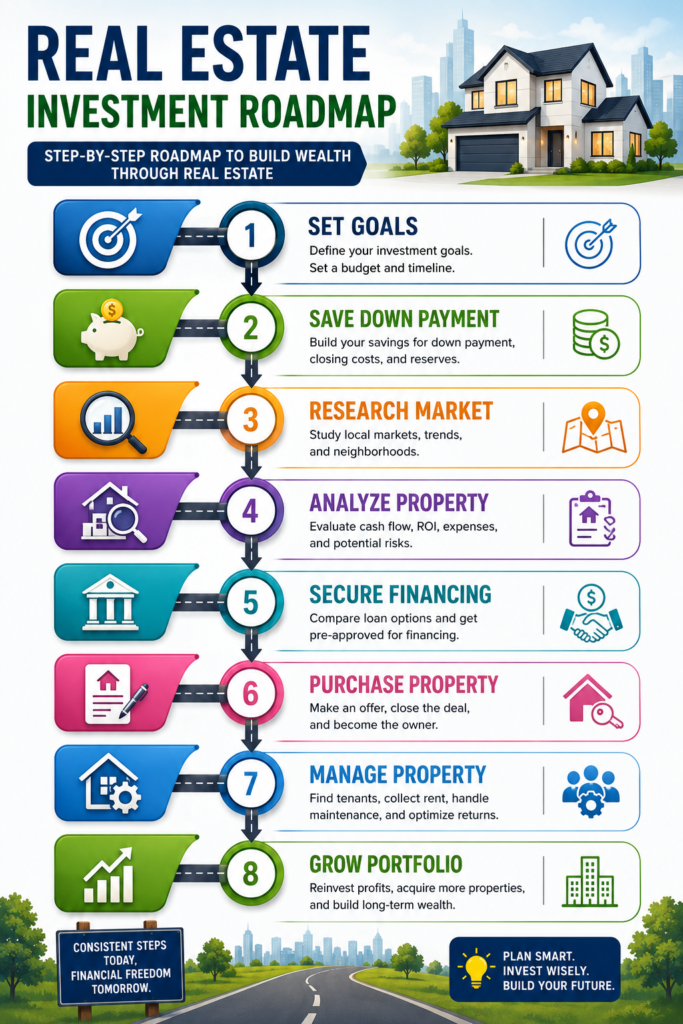
Decide which approach aligns with your goals.
Examples include:
- Long-term rentals
- Short-term vacation rentals
- REIT investing
- House hacking
- Commercial property
- Real estate crowdfunding
Avoid following trends simply because they are popular.
Step 3: Research Multiple Markets
Never purchase the first attractive property you see.
Compare several locations based on:
- Rental demand
- Price trends
- Infrastructure
- Employment opportunities
- Population growth
- Vacancy rates
Research often reveals opportunities that are not immediately obvious.
Step 4: Analyze Several Properties
Use consistent evaluation criteria.
Review:
- Purchase price
- Rental income
- Repair costs
- Cash flow
- Cap rate
- Occupancy potential
- Appreciation prospects
Comparing multiple properties helps you recognize true value.
Step 5: Make a Conservative Offer
Avoid stretching your budget simply to secure a property.
A disciplined purchase price can improve long-term returns and reduce financial stress.
Step 6: Manage the Property Professionally
Whether you manage the property yourself or hire a professional manager, prioritize:
- Regular maintenance
- Good tenant communication
- Timely repairs
- Accurate accounting
- Legal compliance
Good management helps preserve both income and property value.
Step 7: Reinvest Profits
Many successful investors use rental income to:
- Pay down loans faster
- Purchase additional properties
- Improve existing properties
- Diversify into REITs or other investments
Compounding works in real estate just as it does in other asset classes.
Warning Signs to Avoid Before Buying a Property
Some opportunities look attractive on paper but may carry significant hidden risks.
Be cautious if you notice:
- Unusually low prices without a clear explanation
- Structural cracks
- Water damage
- Poor neighborhood maintenance
- High vacancy rates
- Unverified ownership documents
- Unrealistic rental income claims
- Legal disputes involving the property
- Lack of future infrastructure development
- Declining local employment
Taking time to investigate these issues can help you avoid costly mistakes.
Should You Invest During High Interest Rates?
Higher interest rates generally increase borrowing costs, but they do not automatically make every investment a poor decision.
Instead of focusing only on interest rates, evaluate:
- Property price
- Expected rental income
- Local demand
- Cash flow
- Long-term appreciation
- Your financial stability
Some investors find opportunities during higher-rate environments because competition may decrease and sellers become more willing to negotiate.
The right investment depends on the property’s fundamentals rather than one economic indicator.
Real Estate vs Other Popular Investments
| Investment | Income Potential | Risk Level | Liquidity | Long-Term Growth |
|---|---|---|---|---|
| Real Estate | Rental income | Medium | Low | High |
| Stocks | Dividends (some) | Medium to High | High | High |
| Mutual Funds | Moderate | Medium | High | Good |
| Gold | Limited | Low to Medium | High | Moderate |
| Fixed Deposits | Interest | Low | Medium | Low |
| REITs | Dividends | Medium | High | Good |
Each investment has advantages and limitations. A diversified portfolio often helps reduce overall risk.
Frequently Asked Questions (Real Estate Investing Tips)
Is real estate investing good for beginners?
Yes, provided beginners invest after thorough research, understand financing, maintain emergency savings, and focus on long-term goals rather than quick profits.
How much money do I need to start investing in real estate?
The required amount depends on your investment strategy, local property prices, financing options, and associated costs. Some investors begin with REITs or crowdfunding platforms that require less capital than purchasing a physical property.
What is the safest type of real estate investment?
There is no universally “safest” investment. Well-researched properties in areas with stable demand and strong fundamentals generally carry lower risk than speculative investments.
Is rental income passive?
Rental properties can generate recurring income, but they still require management, maintenance, and tenant oversight unless you hire a property manager.
What is a good cap rate?
An appropriate cap rate varies by market, property type, and risk profile. It should be evaluated alongside cash flow, appreciation potential, financing costs, and local market conditions.
Should I buy one expensive property or multiple smaller ones?
The answer depends on your financial goals, available capital, diversification strategy, and ability to manage multiple properties. There is no one-size-fits-all approach.
Can I invest in real estate without buying property?
Yes. Options such as REITs and real estate crowdfunding allow investors to gain exposure without directly owning physical property.
How long should I hold a real estate investment?
Many successful investors adopt a long-term approach, allowing time for appreciation, rental income, and loan amortization to work together. The ideal holding period depends on your goals and market conditions.
What is the biggest mistake new investors make?
Many beginners buy based on emotions instead of financial analysis. Failing to calculate cash flow, repair costs, vacancies, and financing expenses can significantly reduce returns.
Is real estate better than stocks?
Neither asset class is inherently better. They serve different purposes and have different risk-return profiles. Many investors include both in a diversified portfolio.
Final Thoughts
Real estate investing is not about finding a perfect property or making one lucky purchase. It is about building a repeatable investment process based on research, financial discipline, and long-term thinking.
The most successful investors rarely chase trends or attempt to predict every market movement. Instead, they focus on buying quality assets, understanding local markets, managing risk carefully, and making decisions supported by data rather than emotion.
If you are just starting your investment journey, begin with education before committing capital. Learn how to analyze properties, understand financing, estimate cash flow, and evaluate risk. Even experienced investors benefit from reviewing their strategies regularly and adapting to changing market conditions.
While no investment guarantees profits, following proven principles, maintaining realistic expectations, and staying patient can improve your chances of building sustainable wealth over time.
Whether you choose rental properties, REITs, commercial real estate, or another investment approach, consistency and informed decision-making are likely to have a greater impact than trying to time the market perfectly.
By applying the 25 real estate investing tips shared in this real estate investing tips, creating a clear investment plan, and continuing to expand your knowledge, you can build a stronger foundation for long-term financial success while making more confident investment decisions.
Natalie Kingsley is the lead author and primary contributor at Fundznests.com. She is passionate about financial education and dedicated to helping readers build confidence in managing their money, growing their wealth, and achieving long-term financial goals.
With a strong interest in personal finance, investing, retirement planning, and wealth-building strategies, Natalie creates informative and practical content designed for both beginners and experienced investors. Her writing focuses on breaking down complex financial concepts into clear, actionable insights that readers can apply to their everyday financial lives.