
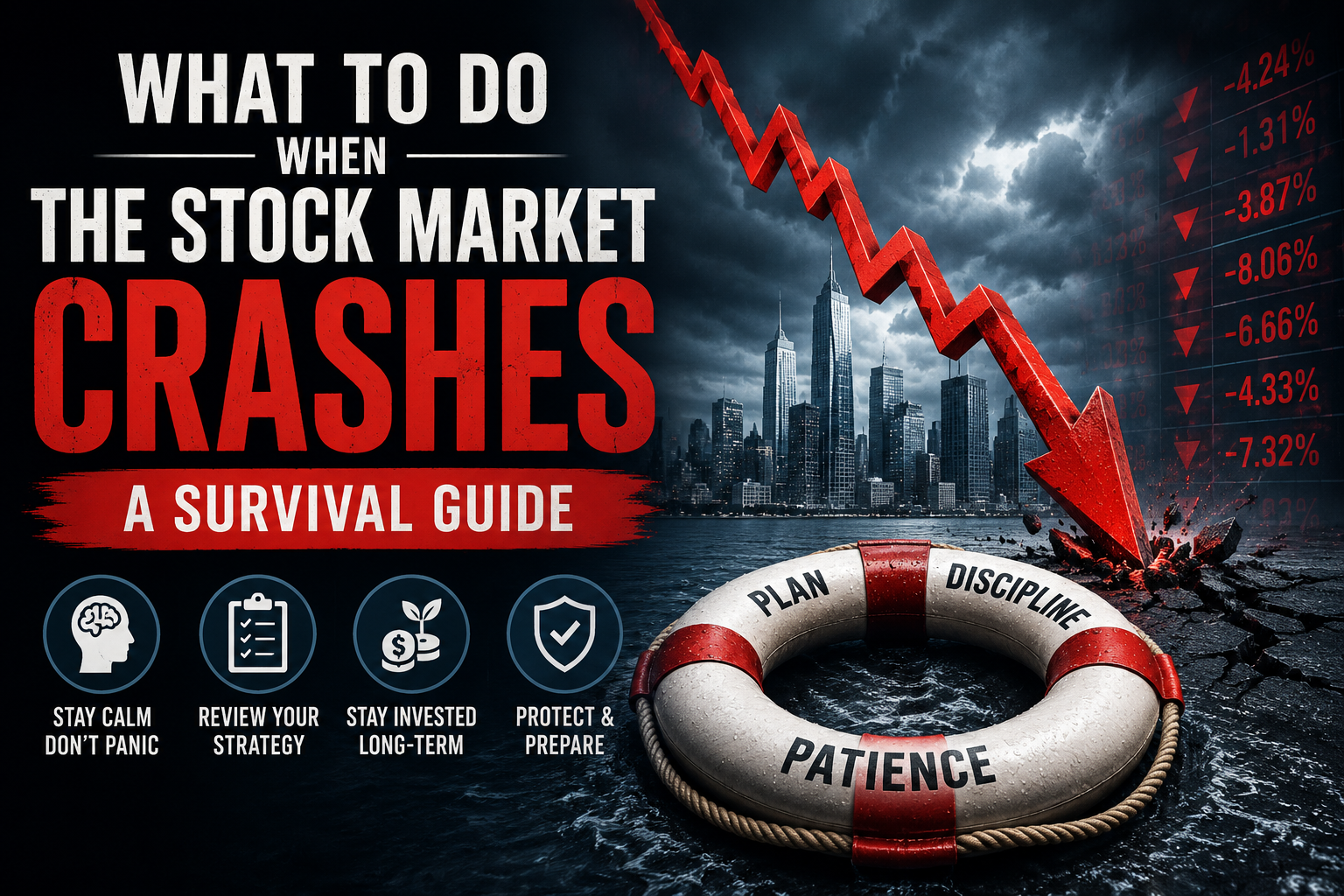
Stock market crashes are among the most feared events in the financial world. Seeing investment portfolios lose value within days or even hours can trigger panic, uncertainty, and emotional decision-making. However, market crashes are a normal part of the investing cycle. History has repeatedly shown that while markets may experience significant downturns, they also have the ability to recover and reach new highs over time.
Understanding how to respond during a market crash can make the difference between long-term financial success and costly mistakes. This survival guide explains practical steps investors should take when the stock market crashes and how to position themselves for future growth.
Understanding Stock Market Crashes
A stock market crash occurs when stock prices decline rapidly over a short period. These crashes can be caused by various factors, including economic recessions, geopolitical tensions, financial crises, inflation concerns, interest rate hikes, or unexpected global events.
Some of the most notable market crashes in history include:
- The Great Depression crash of 1929
- Black Monday in 1987
- The Dot-Com Bubble burst in 2000
- The Global Financial Crisis of 2008
- The COVID-19 market crash of 2020
While each crash has unique causes, they all share one common characteristic: widespread fear among investors.
Stay Calm and Avoid Panic Selling
The first and most important rule during a market crash is to remain calm.
Panic selling often locks in losses that might otherwise recover over time. Many investors sell their holdings during steep declines because they fear prices will continue falling indefinitely.
History demonstrates that markets have consistently recovered from major downturns. Investors who remain invested during periods of volatility often benefit when the market rebounds.
Before making any decisions, take time to assess your financial situation and investment goals rather than reacting emotionally to short-term market movements.
Review Your Investment Strategy
A market crash is an excellent opportunity to evaluate your investment strategy.
Ask yourself:
- Why did you make these investments?
- Has your long-term goal changed?
- Are your investments aligned with your risk tolerance?
- Do you have adequate diversification?
If your original investment thesis remains valid, a temporary market decline may not justify major portfolio changes.
Investing should always be guided by a well-defined plan rather than market emotions.
Focus on Long-Term Goals
Successful investing is typically a long-term endeavor.
Whether you are saving for retirement, building wealth, or funding future expenses, your financial goals likely extend years or even decades into the future.
Market crashes can feel devastating in the moment, but they often represent only a small chapter in a long investment journey.
Long-term investors who maintain discipline are generally better positioned to benefit from future market recoveries.
Rebalance Your Portfolio
When markets fall sharply, your portfolio allocation may shift significantly.
For example, if stocks decline substantially while bonds remain stable, your portfolio may become more conservative than intended.
Rebalancing involves adjusting your holdings to restore your desired asset allocation.
Benefits of rebalancing include:
- Managing risk
- Maintaining diversification
- Taking advantage of lower asset prices
- Supporting long-term investment discipline
Many professional investors view market downturns as ideal times to rebalance portfolios.
Continue Dollar-Cost Averaging
Dollar-cost averaging involves investing a fixed amount of money at regular intervals regardless of market conditions.
This strategy offers several advantages during market crashes:
- Reduces emotional investing
- Purchases more shares when prices are low
- Lowers average cost per share over time
- Promotes consistent investing habits
Investors who continue contributing during downturns often benefit significantly when markets recover.
Rather than trying to predict market bottoms, dollar-cost averaging allows investors to remain engaged while minimizing timing risks.
Maintain an Emergency Fund
Market crashes often coincide with economic uncertainty.
Having an emergency fund can help prevent the need to sell investments at unfavorable prices.
Financial experts commonly recommend maintaining three to six months of living expenses in a liquid savings account.
An emergency fund provides:
- Financial security
- Reduced stress during downturns
- Protection against job loss
- Flexibility to keep investments intact
This safety net can be invaluable during periods of market volatility.
Look for Buying Opportunities
Market crashes often create attractive investment opportunities.
Strong companies with solid fundamentals may experience significant price declines alongside the broader market despite maintaining healthy business operations.
Investors should consider evaluating:
- Industry-leading companies
- Dividend-paying stocks
- Broad market index funds
- Exchange-traded funds (ETFs)
- High-quality growth stocks
However, it is important to conduct thorough research and avoid investing solely because prices have fallen.
A lower price does not automatically make an investment a good value.
Avoid Constantly Checking Your Portfolio
Watching portfolio values fluctuate daily can increase stress and encourage poor decisions.
During volatile markets, many investors develop a habit of checking account balances multiple times per day.
This behavior can amplify anxiety and lead to emotional reactions.
Instead:
- Review investments periodically
- Focus on long-term progress
- Follow your financial plan
- Avoid financial news overload
Maintaining perspective helps investors make rational decisions.
Diversification Becomes Even More Important
Diversification is one of the most effective risk-management tools available.
A diversified portfolio spreads investments across different asset classes, sectors, industries, and geographic regions.
Diversification may include:
- Domestic stocks
- International stocks
- Bonds
- Real estate investments
- Commodities
- Cash equivalents
Although diversification cannot eliminate losses entirely, it can reduce the impact of severe declines in any single investment.
Understand Market Cycles
Markets naturally move through cycles of growth and decline.
Typical market phases include:
- Expansion
- Peak
- Contraction
- Recovery
Understanding these cycles can help investors maintain realistic expectations.
Market crashes are often followed by recovery periods, although the timing can vary significantly.
Recognizing that volatility is a normal component of investing can reduce fear during downturns.
Learn from Past Market Crashes
Historical data provides valuable lessons.
Consider the following examples:
The 2008 Financial Crisis
Global markets suffered severe losses, but investors who remained invested eventually saw significant recoveries as economies stabilized.
The COVID-19 Crash
In early 2020, markets experienced one of the fastest declines in history. Yet major stock indexes recovered rapidly and reached new highs in subsequent years.
The Dot-Com Bust
Technology stocks experienced massive declines, but innovative companies ultimately reshaped the global economy and created enormous long-term value.
History consistently rewards patient investors.
Seek Professional Financial Advice
Not every investor has the same financial circumstances.
If a market crash creates uncertainty, consulting a qualified financial advisor may be beneficial.
An advisor can help:
- Assess risk tolerance
- Review investment objectives
- Develop a recovery strategy
- Improve portfolio diversification
- Provide emotional guidance during volatility
Professional advice can be especially valuable during periods of market stress.
Common Mistakes to Avoid During a Crash
Many investors make avoidable mistakes during downturns.
These include:
Panic Selling
Selling investments solely out of fear often results in permanent losses.
Trying to Time the Market
Predicting exact market bottoms is extremely difficult, even for professionals.
Following Media Hype
Sensational headlines can exaggerate fears and encourage poor decisions.
Ignoring Diversification
Concentrated portfolios are often more vulnerable during market downturns.
Abandoning Long-Term Plans
Changing strategies based on short-term events can undermine financial goals.
Building a Crash-Proof Mindset
A successful investor mindset focuses on discipline rather than emotion.
Key principles include:
- Think long term
- Accept market volatility
- Stay diversified
- Continue investing regularly
- Learn from historical market behavior
- Focus on fundamentals
Investors who develop these habits are generally better equipped to navigate future market downturns.
Conclusion
A stock market crash can be intimidating, but it does not have to derail your financial future. Markets have faced wars, recessions, financial crises, pandemics, and countless unexpected challenges throughout history. Despite these obstacles, they have consistently demonstrated resilience and long-term growth.
The most effective response during a market crash is to remain calm, stay focused on long-term objectives, maintain diversification, continue investing strategically, and avoid emotional decisions. By following these principles, investors can transform market downturns from frightening experiences into opportunities for long-term wealth creation.
Remember, successful investing is not about avoiding every market decline. It is about having the discipline to survive them and the patience to benefit from the recovery that often follows.
Natalie Kingsley is the lead author and primary contributor at Fundznests.com. She is passionate about financial education and dedicated to helping readers build confidence in managing their money, growing their wealth, and achieving long-term financial goals.
With a strong interest in personal finance, investing, retirement planning, and wealth-building strategies, Natalie creates informative and practical content designed for both beginners and experienced investors. Her writing focuses on breaking down complex financial concepts into clear, actionable insights that readers can apply to their everyday financial lives.